



50 years since Nobel winning discovery in Menlo Park
On November 8, the science community celebrated 50 years since a discovery changed the game for understanding our universe. SLAC National Accelerator Laboratory in Menlo Park hosted scientists from around the world discussing the moment two teams — from SLAC/Berkeley and MIT/Brookhaven Lab — announced they had uncovered a new particle back in 1974. Called the J/psi (pronounced Jay-sigh) particle, its discovery won a Nobel Prize in physics for both teams and set off global experiments in what became known as the November Revolution.
“You couldn’t ignore it. This changed the way the whole particle physics community thought about the strong interactions [between quarks and antiquarks] and, more generally, the fundamental interactions of nature,” said Michael Peskin, professor of particle physics and astrophysics at SLAC National Accelerator Laboratory. “Within a decade, we’d built something called the Standard Model, which still stands up today and is an excellent explanation for the observed sub-nuclear forces. This is used now not only in particle physics, but in nuclear physics, in astronomy, in theories of the earliest ages of the universe.”
People on those 1974 experiment teams, some just grad students at the time, spoke about how they achieved the breakthrough and the impact it still has for modern day science. Brookhaven, Berkeley Lab and SLAC are Department of Energy National Laboratories, with SLAC operated by Stanford University. Particle science remains a major part of SLAC’s effort in Menlo Park. The lab explores how the universe works at the biggest, smallest and fastest scales to help develop new materials and chemical processes and open unprecedented views of the cosmos.
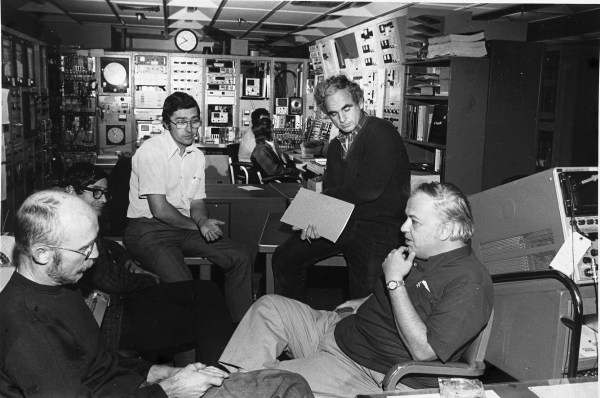
Top photo shows group of physicists seated in SPEAR control center. Second from the left in this photo is George Trilling of UC Berkeley, one of the leaders of the Berkeley physics group that collaborated with SLAC Experimental Groups C and E in the SPEAR studies of hadron production in the early 1970’s. Others (left to right) are SLAC physicists Rudy Larsen, Ewan Paterson, David Fryberger, and Burt Richter.1974. Published in November/December 1975 Beam Line. Courtesy SLAC National Accelerator Laboratory, Archives and History Office.
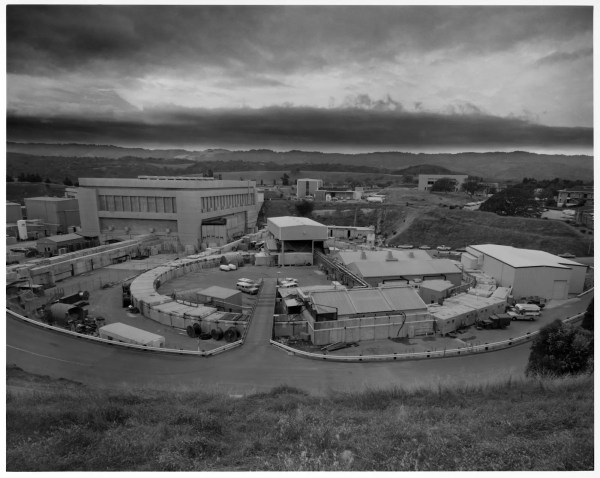
Second. photo: PEAR collider at SLAC used in the discovery of the J/Psi particle, December 8, 1975