Mitchell Johnson’s 20 years in Truro: Color, art history, and an independent path

When Mitchell Johnson walks into his Menlo Park studio, he is often surrounded by works that will travel far beyond his adopted hometown. His paintings are owned by museums such as Museo Morandi in Bologna, the Tampa Museum of Art and Bornholms Kunstmuseum, and they have appeared on the big screen in It’s Complicated, The Holiday, and Crazy, Stupid, Love. Yet just as often, he shares them with neighbors who stop by his studio and in local exhibitions at Flea Street in Menlo Park — a reminder that his national presence is grounded in a quiet, steady commitment to the community where he lives and works.
This September, Johnson opens “Twenty Years in Truro (Selected Paintings 1989–2025)” at the Truro Center for the Arts at Castle Hill in Massachusetts, marking two decades of painting on Cape Cod and 45 years as a working artist. The exhibition arrives at a moment when the art world itself feels fragile: in recent months, major outlets like The New York Times, Artnet, and The Art Newspaper have reported the closures of long-standing powerhouse galleries, including Blum (formerly Blum & Poe), Kasmin, CLEARING, Venus Over Manhattan, and Tanya Bonakdar’s Los Angeles outpost. The instability has sparked speculation about what comes next for artists caught in the endless turbulence that defines the art world.
For Johnson, the story has been different — painting as a search for color fluency and personal expression. Johnson’s Truro canvases are not conventional landscapes. They are structured meditations on color, rhythm, and form. Planes of blue, ochre, and red interact with a discipline rooted in the story of modern painting — from Matisse and Morandi to Diebenkorn.
“Color has always been the subject,” Johnson has said, and Cape Cod has provided him with a place to test how memory, place, and history can be distilled into structure and color commentary.
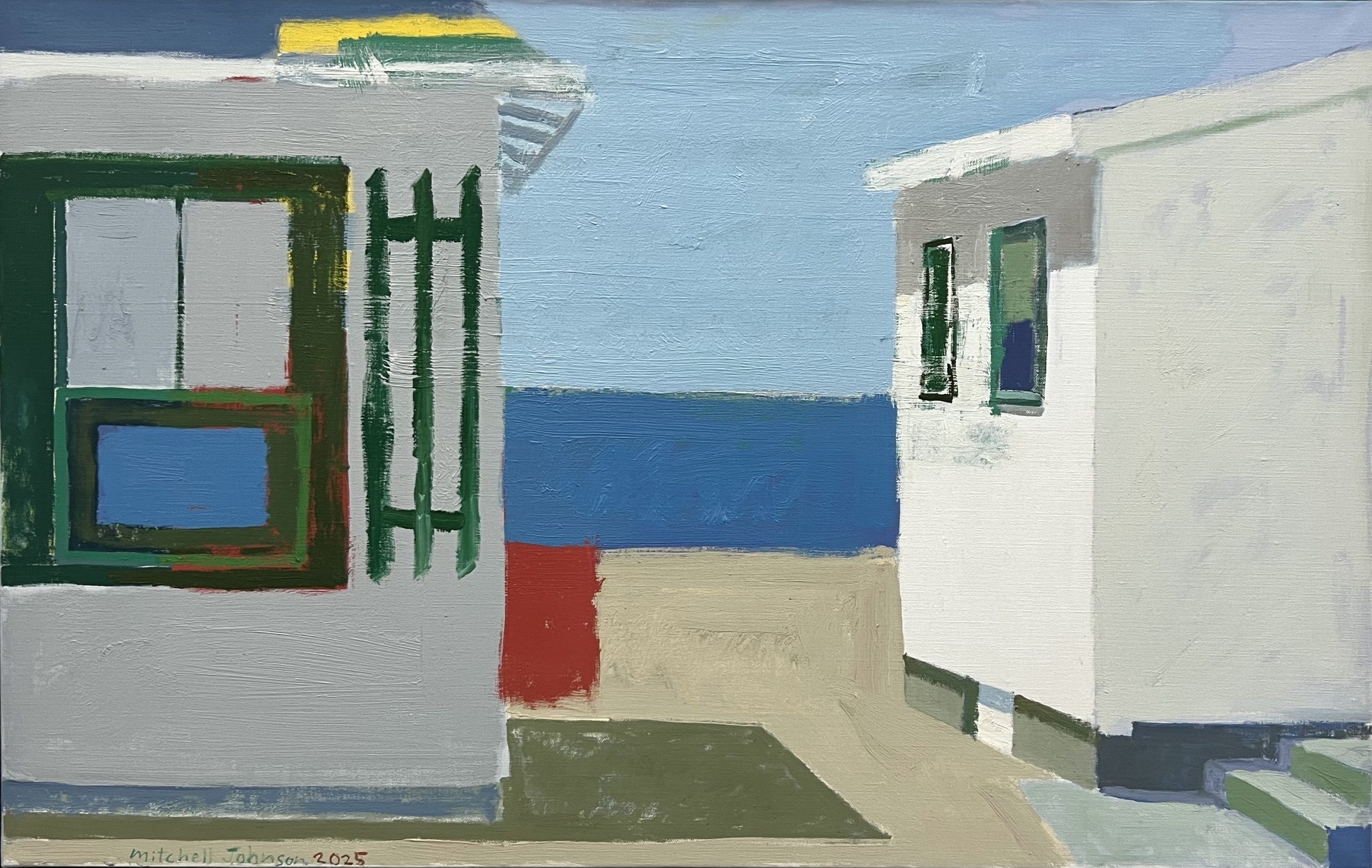
In Whitehot Magazine critic Donald Kuspit has called Johnson “a master of abstraction” whose canvases “cut the Gordian knot of representation and abstraction.” For Kuspit, Johnson’s geometry doesn’t just describe the world — it holds and controls emotion, transforming observation into something both clear and complex.
Johnson’s reverence for art history is not incidental. In Bologna, where Johnson’s work is in the collection of the Museo Morandi, the connection to Giorgio Morandi’s still-lifes is clear. And Bologna is the site of his watershed moment of encountering Morandi alongside of Josef Albers in the historic 2005 pairing of the Modern Masters.
Johnson’s paintings are explorations of how color and structure can carry meaning and homage across time, from Italy to New England to California — a career that built its own lane .
Equally striking is how Johnson has managed his career. In the 1990s and early 2000s, he exhibited with major galleries in New York, Santa Fe, Los Angeles and San Francisco. But by the time the financial crisis of 2008 thinned the ranks of many mid-tier galleries, Johnson was already shifting course. He began to rely less on a gallery system that was shrinking and more on a mix of non-gallery exhibits, museum placements, magazine ads and features, and film appearances.
That independence has carried him through more than 15 years of volatility in the art market. His paintings have appeared on the back covers of The New Yorker and The New York Times Magazine. They’ve entered more than 35 museum collections. And every September, he returns to Castle Hill in Truro to teach a popular master color class, keeping one foot firmly in the mysteries of color perception that underpin his career.
It is a model that looks prescient today. With closures mounting from New York to Los Angeles, Johnson demonstrates that an artist can maintain visibility and continuity without relying on institutions whose survival is uncertain. His career has traveled alongside the gallery world, but not within it — close enough to be in dialogue, independent enough to expand and endure.
For all his reach, Johnson remains a Bay Area painter with local ties. He has lived in Menlo Park for decades, and while his works are held in major museums and circulate internationally, he continues to exhibit in his hometown. That balance — local and global, community and history — mirrors the duality of his paintings themselves. They are of a place, yet shaped by a lineage of artists across continents.
As the art world recalibrates, “Twenty Years in Truro” is not only a survey of Johnson’s Cape Cod work. It is also a case study in how an artist can build a career by honoring both color and art history, while negotiating the market on independent terms. In an era when the gallery system feels less certain than ever, Johnson’s path looks less like an exception and more like a model worth studying.
Exhibition details: “Twenty Years in Truro (Selected Paintings 1989–2025)” Truro Center for the Arts at Castle Hill, 10 Meetinghouse Road, Truro, Massachusetts , September 3–14, 2025 Reception: September 4 ; Artist talk: September 5.
Top photo: Mitchell Johnson painting in North Truro, May 2005; second photo is his painting titled “North Truro (Red and Yellow),” 2025, 24×48 inches, oil/canvas.