

A Dialogue Across Time: Chardin in São Paulo
 The Museum de Arte de São Paulo (MASP) sits on Avenida Paulista, dramatically interrupting the canyon of towers that line the city’s main artery. Designed by Lina Bo Bardi, the museum is a glass-walled prism suspended above the ground by two red prestressed concrete beams. Bo Bardi saw this vão livre (open space) beneath the structure as critical to complementing and embracing the energy of the city – a vision that persists today, as the large shaded span has become a civic stage frequently occupied by markets, protests, and cultural events.
Bo Bardi’s vision for the building included a lasting curatorial imprint. In the picture gallery, paintings rest on “crystal easels”: thick glass sheets set into concrete blocks, with the labels fixed to the backs. The layout encourages a more democratic viewing experience where visitors gravitate toward works that speak to them rather than simply famous names. The easels are organized in horizontal, parallel rows, beginning with contemporary Brazilian artists before moving backward through art history. Mounted on these sheets of clear glass, the paintings float in space, allowing viewers to peek between canvases and spot a work two or three rows back.
The gallery layout transforms the hierarchy of art history into an evolution, creating a space where viewers are freed from the traditional groupings of the canon and can instead explore natural connections between artists working across centuries. It was in this setting that, as I considered a contemporary figurative painting by Brazilian artist Wallace Pato, I caught a glimpse of a familiar figure on a canvas several rows back – could it be Chardin?
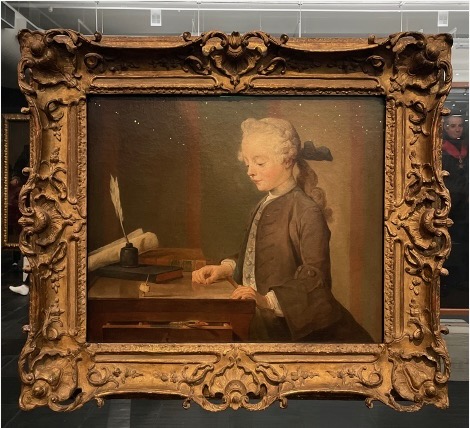
Stepping forward, I found Jean-Baptiste-Siméon Chardin’s Portrait of Auguste Gabriel Godefroy, a 1741 variant of his Boy with a Spinning-Top at the Louvre. Having always seen Chardin in period rooms alongside contemporaries such as Watteau or Fragonard, encountering his work among modern and contemporary pieces underscored the timelessness of his painting. His quiet reflection on everyday bourgeois life, in many ways, has more in common with Pato’s scene than with the flowery, stylized depictions of opulence favored by Chardin’s peers. The act of the young boy spinning a top – his trained eyes tracking it, his preference for play over study conveyed in a single gesture – has a universality that mirrors Pato’s figure, shirt half unbuttoned, leaning against a doorframe with a glass of beer in hand.
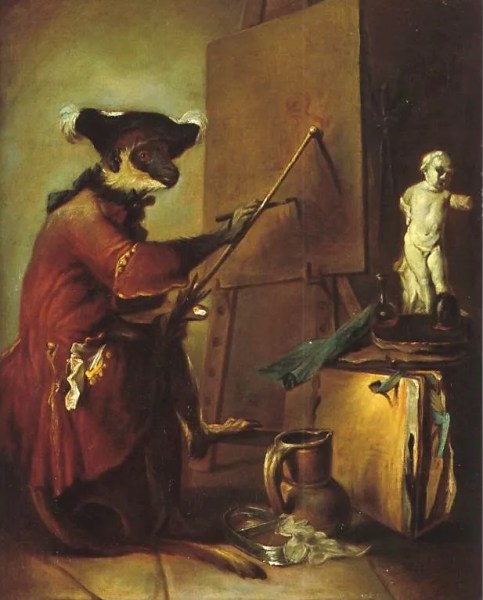 The slices of the human experience that each work presents transcend time periods and, in this case, cultures and continents. Chardin distanced himself from his contemporaries with canvases like Portrait of Auguste Gabriel Godefroy and, at times, mocked artistic pretension directly, as in Le Singe peintre (The Monkey Painter), his satirical portrait of a monkey painting – a jab at the art world’s obsession with show over substance
Part of the jolt I felt upon spotting the Chardin is linked to the wider sensory experience of São Paulo itself — most notably, its visual dimension. The city’s daily palette — saturated greens and yellows of limes and passion fruit strung in a lanchonete, the pastel pink of a neighborhood church, the clash of sky and royal-blue tiles on an apartment façade – reframes what we bring to the museum. Dalton Paula’s portraits are the first paintings you see upon entering the gallery, their sky-blue backgrounds a natural continuation of the vivid hues of the street.
Arriving at Chardin’s Portrait of Auguste Gabriel Godefroy at MASP is fundamentally different from descending into the Louvre Pyramid and navigating a maze of galleries to find Boy with a Spinning-Top. Chardin’s softer interior reads differently — like tasting tarte Tatin after feijoada rather than after boeuf bourguignon. It is not necessarily incongruous, merely unfamiliar – its meaning and tone subtly transformed by sensory context.
Despite his muted palette, Chardin does not lack vitality. From across the room, the painting’s quiet force draws you in; up close, it rewards sustained looking through its delicate dialogue of light and shadow. Auguste Gabriel’s knuckles are gently illuminated, reflecting softly on the tabletop. The spinning top and the pen poking out of the desk drawer echo each other’s shadows. Chardin deepens our engagement by working the edges of the canvas, as the bottom of the drawer and the white scroll disappear beyond the frame. Though the boy is ostensibly the painting’s subject, the true theater occurs in this lower-left quadrant – a compact scene of motion, reflection, and quiet revelation.
MASP’s iconic gallery layout makes this cross-temporal conversation visible. By flattening hierarchies – labels turned away, chronology loosened – Bo Bardi opens a dialogue across hemispheres, between past and present, Europe and Brazil. The format honors painters of earlier centuries while allowing them to be seen anew. In São Paulo, Chardin’s relevance is not solely inherited from the canon but re-earned through encounter, underscoring his timelessness and enduring importance in the evolution of painting.
Top painting: Jean-Baptiste-Siméon Chardin, Portrait of Auguste-Gabriel Godefroy, 1741.
Second painting: Jean-Baptiste-Siméon Chardin, Le Singe peintre (The Monkey Painter), 1739–1740.
Raised in Menlo Park, Luca Johnson is currently doing an exchange semester at FGV, Brazil’s business school