A new world record set in Menlo Park: LCLS approaches 100,000 pulses per second
Two years after teams at the Department of Energy’s SLAC National Accelerator Laboratory in Menlo Park celebrated completion of the Linac Coherent Light Source (LCLS) upgrade project, LCLS-II, the X-ray laser has reached a major milestone: delivering 93 kHz — almost 100,000 pulses per second — a new world record for X-ray free-electron lasers. The achievement marks a critical step toward the machine’s goal of up to 1 million pulses per second, 8,000 times more than the original machine.
Experiments running at these higher pulse rates will allow scientists to capture ultrafast processes with greater precision, collect data more efficiently and explore phenomena that were previously out of reach. It transforms the ability of scientists to explore atomic-scale, ultrafast phenomena that are key to a broad range of applications, from quantum materials to energy technologies and medicine.
“For over a decade, we’ve planned a multi-year ramp to full power,” said John Schmerge, director of SLAC’s Accelerator Directorate. “It’s one thing to design the machine and build it, but ramping up the power is where you find out if everything really works the way it was designed to. Every milestone brings us closer to delivering the science that LCLS-II was built to do.”
Safely building up to 1 million pulses per second, or 1 MHz, requires a staged program of commissioning and power increases as the accelerator, undulators and experimental systems are qualified for higher duty cycles.
Accelerator teams are currently running LCLS at a rate of up to 33 kHz, or 33,000 pulses per second, for user experiments. Achieving this rate was already a major milestone, beating out the previous world record of 27,000 pulses per second held by the European XFEL.
“We ramp systematically because we don’t want to damage the machine,” Schmerge said. “The plan has always been to increase the beam power one safe step at a time. The approach is deliberate, methodical and essential for ensuring the reliability of the accelerator and the safety of the scientific instruments downstream.”
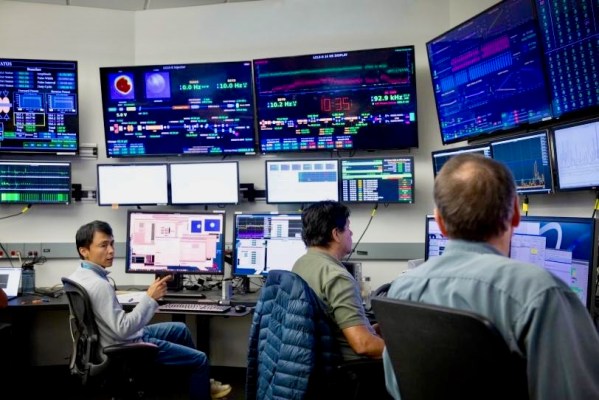
From left, Yuantao Ding, William Colocho and Franz-Josef Decker in SLAC’s accelerator control room during the ramp-up to 93 kHz.(Olivier Bonin/SLAC National Accelerator Laboratory)