



The Other Side of the Creek: Stanford’s Red Barn and the Experiment of June 1878

Editor’s note: “The Other Side of the Creek” is a series designed to capture the life and spirit just beyond San Francisquito Creek — the shared landmark separating Menlo Park from the communities to the south. And we think this one makes a great summer read!
Introduction
Most old buildings at Stanford have new jobs today. The Red Barn — now at 621 Fremont Road near Electioneer Road — is different. It was built for horses back when the land was Leland Stanford’s Palo Alto Stock Farm, and horses still live there now. Students call the whole campus the Farm, often without asking why.
This article is about one thing that happened on that farm, and a man, Eadweard Muybridge, whose life included a stagecoach crash, a murder trial, orphanages, and a world’s fair. The story will follow him through all of that.
But the center of it is one week in June 1878: who paid for the experiment, what happened on the track, which parts are proven, which parts are legend, and what did — and did not — come from half a second of photography?
The Question and the Money
Around 1872 (though some accounts say 1873), Leland Stanford became involved in the problem. Running the railroad had damaged his health, and his doctors told him to find a hobby. He chose horses. With horses came one of the strangest arguments of the age: does a running horse ever have all four feet off the ground at once? The human eye could not see fast enough to tell. Painters had guessed for centuries — and they usually guessed wrong.
A persistent legend says Stanford had a $25,000 bet riding on the answer. Historians have looked for that bet and found no reliable evidence for it. What they found instead was a rich man who wanted to be right, and a horse breeder who wanted faster horses. The record shows something smaller and, in a way, more interesting: Stanford offered $2,000 to a photographer to try something the photographer himself first said was impossible. Camera plates in that era usually needed much more time than this job allowed. Stanford needed something closer to a thousandth of a second.
The Photographer
Muybridge took a strange road to that job. He was born Edward James Muggeridge in Kingston upon Thames, England, in 1830. At 20, he moved to America to sell books, and he kept changing his name along the way: Muggridge, then Muygridge, then the pen name Helios, and finally Eadweard, an Old English spelling he seems to have copied from a king’s name carved on a stone in his hometown.
In July 1860, a runaway stagecoach in Texas crashed and threw him headfirst onto rock. He woke up in Fort Smith, Arkansas, with no memory of the past nine days. For months afterward he saw double and lost his hearing, taste, and smell. He went back to England to recover. A doctor named William Gull told him to work outdoors and find a new career, so he learned wet-plate photography and even filed at least two British patents.
A Berkeley psychologist named Arthur Shimamura later suggested that the crash may have damaged the front part of Muybridge’s brain, the part that helps control emotion, and that his hot temper in later years may have begun there. That remains a theory, not a proven fact.
By 1868, Muybridge’s huge photographs of Yosemite had made him famous. By the early 1870s, he was one of the best-known photographers on the West Coast: a wild-looking man with a stained white beard. One person who knew him said he looked like “Walt Whitman ready to play King Lear” .
The Killing and What Came After
The experiment stopped in October 1874, and any honest account has to say why. Muybridge discovered that his young wife, Flora, who had married him at 21 (half his age), was having an affair with a theater critic named Harry Larkyns. Along with the letters, he found a photo of the baby boy he had believed was his own son. On the back were written the words “Little Harry”.
On October 17, Muybridge traveled by boat, train, and a nighttime carriage ride to Calistoga. He got Larkyns to come to a doorway, shot him at close range, and turned himself in. The trial took place in Napa in February 1875. The jury ignored the judge’s instructions and set him free.
On paper, they called the killing justifiable homicide, meaning legally excused. In practice, it was the old unwritten rule that a cheated husband could kill. The jury reached that verdict even though a witness testified that Muybridge had calmly said he planned the killing and regretted nothing. The court record also shows that his defense team was led by a friend of Leland Stanford’s.
Most retellings leave out what happened to the other two people in the story. Flora won a court order for support money in April 1875. She died that July, at age 24, while Muybridge was out of the country. Their son, Florado Helios Muybridge, was passed from a French couple to a Catholic orphanage, and then to a Protestant one at his father’s request. The visits stopped around the boy’s tenth year, and Muybridge left him out of his will. Florado worked his whole life as a ranch hand and gardener. Photos of him as an adult show that he looked a lot like the father who kept his distance. In 1944, Florado was hit by a car in Sacramento and killed.
June 1878 on the Track
The work started again in 1877 with a single photo of Stanford’s horse Occident in Sacramento. But the version shown to the press was, as was common then, a photograph of a painting made from the negative. Doubters said it looked touched up. The answer to doubt was a live demonstration, and the setup built for it was a team effort.
Twelve cameras stood in a white shed facing the Stock Farm track. According to Smithsonian, they were spaced 21 inches apart. They were loaded with new, faster-reacting chemicals and fitted with quick sliding shutters. The electric triggers were built with help from Stanford’s engineers. Stanford’s side gave credit for the electromagnetic design to a railroad engineer named John D. Isaacs, a detail that matters later in the story.
On the day of the demonstration in June, a trotting horse named Abe Edgington ran through threads stretched across the track. Twelve cameras fired in about half a second. Within 20 minutes, Muybridge developed the plates right there for the visiting reporters. Frame after frame showed the horse fully in the air, with its legs pulled in under its body, not stretched out like a rocking horse, the way painters had often imagined.
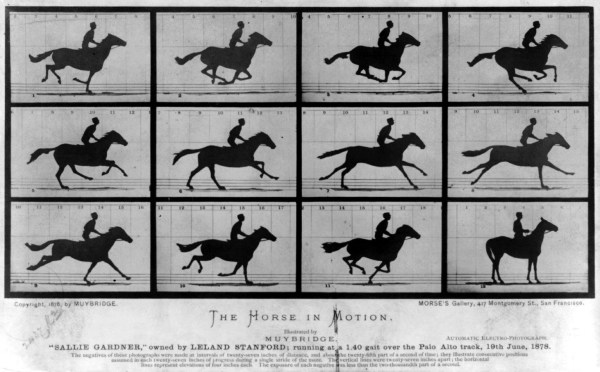
A few days later, on June 19, a mare named Sallie Gardner galloped past the row of cameras at about 40 miles an hour, in front of a numbered backdrop. Each exposure lasted about one one-thousandth of a second, around three hundred times faster than a blink. That settled Stanford’s question of “unsupported transit”, the idea that a running horse is briefly airborne. The camera line kept growing afterward — 12 cameras at first, 24 by the next year’s studies.
One detail complicates the neat version of the story. In the famous set of pictures, the twelfth and final frame shows the horse standing still, and the numbers on the backdrop do not follow the sequence. The Smarthistory analysis concludes that Muybridge probably borrowed that frame from a different series to give the run a clean ending. That fit his habits. For years, he had pasted clouds and moons into empty skies. He also once labeled a staged photo of a U.S. Army scout as a Modoc warrior on the warpath. The man recording reality also edited it.
What Followed, and What Did Not
The pictures spread fast. Scientific American printed copies that fall, and the French science journal La Nature followed. But one point often gets blurred when people celebrate the story. Muybridge’s 1878 setup was not yet a movie camera. Twelve cameras taking one picture each proved that motion could be broken into visible phases, but movies needed a device that could record many images in sequence.
Étienne-Jules Marey moved closer to that problem in 1882 with his chronophotographic gun, a camera-shaped instrument that could take multiple frames with one device. That machine was a more direct ancestor of the motion-picture camera.
Still, Muybridge should not be pushed out of film history. His sequence photographs and later zoopraxiscope helped establish the idea that recorded motion could be analyzed, repeated, and projected. Marey helped move the technology toward the movie camera. Muybridge helped prove why such a machine mattered.
Painters, meanwhile, were shaken. When the famous French horse painter Meissonier was shown the pictures, he declared, “Never again shall I touch a brush!”. He got over it. The artists Degas and Eakins studied the plates. The sculptor Rodin refused to change his ways.
Within a year, Muybridge built a projector he called the zoopraxiscope. It spun hand-drawn copies of his photo sequences on glass discs. Stanford Magazine calls the 1879 showing for the Stanfords the world’s first motion picture. That claim needs caution. Spinning-disc animations had existed for decades. What was new was that real photographs, not pure imagination, stood underneath the drawings. Muybridge toured Europe with the machine, giving shows for famous figures like Prime Minister Gladstone, the poet Tennyson, and the Prince of Wales.
The partnership between Stanford and Muybridge ended in a fight over credit, and the fight has two sides. In 1882, Stanford published a book called The Horse in Motion under the name of his doctor friend, J. D. B. Stillman. The book gave the photographer almost no credit. Muybridge sued Stanford and lost. Nothing between the two men had ever been put in writing.
The costs had also grown far beyond the original $2,000. Stanford’s side argued that the electrical equipment was as much his engineers’ work as Muybridge’s. One Stanford archive even calls Muybridge’s shutter patent a fraud and names Isaacs as the real designer.
Muybridge landed on his feet at the University of Pennsylvania. Between 1883 and 1886, he made over 100,000 images of humans and animals in motion: wrestlers, dancers, an elephant, and even a series titled Chickens Being Frightened by a Torpedo. He posed for some of the nude studies himself. He published the work in 1887 as Animal Locomotion. He met Thomas Edison in 1888 and ran a special theater for his moving pictures at the 1893 Chicago World’s Fair. But within 10 years, new film technology had turned his machine into a museum piece.

The Site Today
Muybridge moved back to England for good in 1894. He published two late books, Animals in Motion and The Human Figure in Motion, both built from the work that had made his name. He died at his cousin’s house in Kingston on May 8, 1904. A later anecdote claims that he had been digging a scale model of the Great Lakes in the backyard, but that story is usually treated as legend, not settled fact. The plainer record is that he died after a disease of the prostate gland.
His ashes lie at Woking under a gravestone that reads “Eadweard Maybridge”. That spelling is usually treated as a posthumous error, not another name change by Muybridge himself. It was one final confusion around a name that had never stayed still.
And on this side of the Atlantic? The Stock Farm became the university named after the founder’s son. The Red Barn was restored, and it still houses horses today, a working leftover from the racing era a short walk from classrooms. A state plaque marks the site of the motion-photography work: California Historical Landmark No. 834, placed in 1983 on Campus Drive West just south of Electioneer. It is easy to miss from a passing car.
Fitting for this story, the plaque remembers the camera line at its later size of 24. The past keeps a low profile on this ground. Sometimes it adds up to 12 clicks on a June morning, faster than a blink — and a horse that, for one measured instant, never touched the ground.
Photos of current Red Barn by Ardan Michael Blum (c) 2026
“The Horse in Motion”, Eadweard Muybridge’s 1878 cabinet card of the mare Sallie Gardner — owned by Leland Stanford — at the Palo Alto Stock Farm. Public domain; Library of Congress, via Wikimedia Commons. The image is in the Public Domain.
Disclaimer: This article is intended for informational and editorial purposes only and reflects independent research and interpretation. Although care has been taken to ensure accuracy, some details may be incomplete or subject to change. Nothing here should be considered professional advice or an official statement by any institution mentioned.
Disclosure: AI tools assist with research, summaries, drafting, and editorial review. Their use varies by article and stage of the writing process. Ardan Michael Blum writes, revises, and updates the content, shapes its arguments and interpretations, and makes the final editorial decisions.


T.D.G July 07, 2026 at 3:20 pm
This is a fascinating look into a piece of local history that many of us drive past every day! It is incredible that the Red Barn still serves its original purpose for horses, maintaining the “Farm” spirit of Leland Stanford’s original Stock Farm.
Wendy July 07, 2026 at 9:48 pm
A fascinating piece of local history!!
Antoine M July 08, 2026 at 3:23 pm
Great article!
Ardan Michael Blum August 28, 2026 at 12:57 pm
For practical visiting information and a concise overview of the Stanford Red Barn’s history, including its Stock Farm origins and connection to Eadweard Muybridge’s motion studies, see the Red Barn section of my independent, noncommercial Palo Alto and Stanford visitor guide: https://diary.ardanmichaelblum.com/palo-alto-tourism-practical-guide/#h.369tm2pwv84x