



Sunset headquarters in Menlo Park determined eligible for the National Register of Historic Places
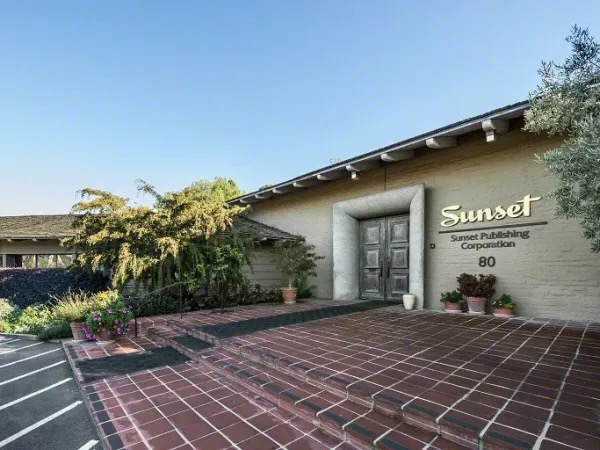
The United States Department of the Interior, has determined the Sunset headquarters in Menlo Park is eligible for listing on the National Register of Historic Places under three separate categories — Architecture, Landscape Architecture, and Commerce.
The Menlo Park Historical Association, a nonprofit founded more than 50 years ago to preserve Menlo Park’s history, sponsored the historic register nomination of the Sunset headquarters. Nominations are highly vetted and must first be reviewed and approved by a state historic resources office before they are sent to Washington for final determination. Now, the Keeper of the Register in Washington has made the final determination that the Sunset Headquarters is eligible for listing on the National Register of Historic Places.
This puts the Sunset headquarters, with its carved sugar pine wood doors, on par with numerous famous properties listed on the National Register. What is especially noteworthy is that the Sunset Headquarters property was determined to have triple layers of historic significance — Architecture, Landscape Architecture, and Commerce.
We often think of buildings and places associated with historic events as being on the National Register, but the Sunset Headquarters property qualifies also under Landscape Architecture. That puts it in the rarified company of other places on the National Register for their Landscape Architecture, including New Orleans Garden District, Central Park in New York, Golden Gate Park, Mount Vernon in Virginia, Harvard Yard in Massachusetts, The Presidio in San Francisco, and Filoli in Woodside, to name a few.
Last month, the California State Historical Resources Commission voted unanimously that the Sunset Headquarters meets the criteria for National Register, after a highly vetted nomination process and adversarial hearing. The California Office of Historic Preservation then forwarded the nomination to Washington for review by the Keeper of the Register, who determined the property eligible for listing on the National Register of Historic Places.
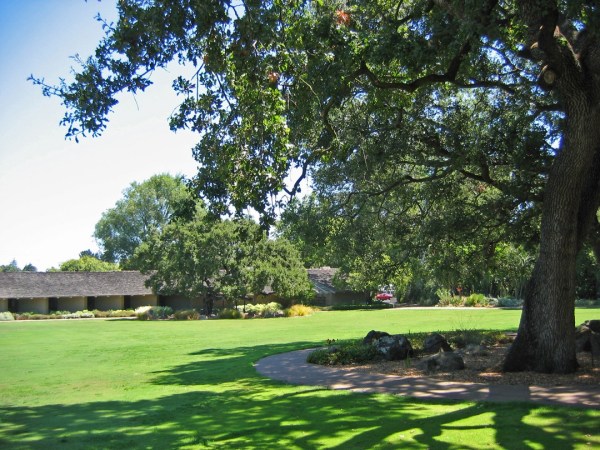
The new owner of the property, Willow Project LLC — a company understood to be owned/controlled by Vitaly Yusufov, the son of Russia’s former Energy Minister under President Putin — has proposed demolishing the iconic building and landscape design to build a massive complex. It would include a series of buildings 301 to 458 feet tall, with a more than 300,000 sf office space, 36,973 sf retail, a 130-room hotel, a 2,670 sf private preschool, and residential units, the minimum of which (20%, under the Builder’s Remedy loophole) would be for those making less than 80% of area’s median income. Consequently, the developer claimed the proposed complex was an “affordable housing” development when he represented the owner at the California State Historical Resources Commission hearing on May 9th.
Economic and social matters, however, may not be considered in the determination of historic register eligibility. It is strictly a historic determination. Commissioner Lee Adams noted at the hearing, “like my colleagues, I’m sympathetic to the social issues, but that’s not our purview. While many public agencies balance those issues, we’re here to balance history, period. Full stop.”
Commissioner Alan Hess noted at the hearing that “the importance of this building is remarkably large.” It has had an “impact on lifestyles, planning, city design, urban design, … [and] economic development of California . . . that raises it to a very high position of significance.” Commissioner Hess has written 19 books on Modern architecture and urbanism in the mid-twentieth century.
The developer argued that changes to the property, including the absence of a tree present in the 1950s, made it ineligible. Commissioner Janet Hansen noted, however, that “trees die and plants die . . . other things may be planted” and the nomination demonstrated “sufficient integrity of the design overall.” The State Historian noted that properties “are not expected to be preserved in amber, buildings and landscapes are expected to experience change over time.” The property’s historic integrity is evaluated for the property as a whole, not individual features like specific plants.
The State Historian presenting the property at the hearing, on behalf of the California Office of Historic Preservation, noted that while the owner objected to the nomination and the developer, on the owner’s behalf, argued against its eligibility, the CEO of the owner and developer had both signed a historic significance report they submitted to the City of Menlo Park in November 2023, prepared by a Secretary of the Interior-qualified Architectural Historian they had hired. That report conceded that the property is historically significant for the Thomas Church landscape design, the Cliff May designed building (which the report called “a unique commercial example of the Ranch House style”), and because Sunset Magazine made “significant contributions to the local and regional history, as well as the cultural heritage of California and the United States.”
California’s State Historic Preservation Officer noted the owner’s historic significance report in the cover letter the California Natural Resources Agency sent to the Keeper National Register of Historic Places in Washington, D.C., forwarding the nomination file in May. The cover letter attached a nomination summary prepared by Office of Historic Preservation that quoted extensively from owner’s report, which report was also attached, with relevant portions conceding the Sunset Headquarters’ historic significance highlighted, so the owner’s report is now also part of the Federal records on the property.
The owner’s historic significance report to the City of Menlo Park is noteworthy also because it disclosed that a “Native American archaeological site was informally recorded on the property at some point in the last few decades, making it potentially sensitive for archaeological resources.” That November 2023 report indicated that the developer had hired an expert archaeological firm to research and prepare a report on the Native American archaeological site, which was to be appended to the historic significance report. It has been more than 19 months now, and the developer still has not submitted the Native American archaeological site report to the City of Menlo Park.
The owner, however, submitted a Letter of Protest against the nomination to the California Office of Historic Preservation in October 2024. Such a letter does not prevent a nomination’s consideration or the determination of a property’s eligibility for listing on the National Register of Historic Places. It does, however, prevent the property from technically being added to the National Register of Historic Places list. If the owner were to change its mind or a future owner wanted the property listed, the property could be listed without going through the nomination process again, assuming the historic integrity remains intact.
As a result of being determined eligible for the National Register, however, Sunset Headquarters has now been automatically listed in the California Register of Historical Resources (pursuant to Section 4851(a)(2) of the Public Resources Code), under the same three separate categories — Architecture, Landscape Architecture, and Commerce. Owner objection cannot prevent that listing. Listing on the California Register of Historical Resources triggers heightened protection of listed properties as historic resources, under the California Environmental Quality Act.
On May 13, the Menlo Park City Council approved a professional services contract to perform the required environmental analysis of the proposed development, under the California Environmental Quality Act. The next step is for the owner/developer to begin that review by getting into contract with and paying the firm Menlo Park approved to do the environmental analysis, which now must consider that the property has been determined to be a historic resource.


Chris Ziegler July 05, 2025 at 1:39 pm
This is great news!
I hope that Sunset Headquarters eligibility for the National Register of Historic Places will nix the atrocious building proposal for that land.
I lived in the Willows for 50 years, and the Sunset building belongs right where it is.