


Fire in the Hills – Part 2: Firefighters share their stories 40 years later
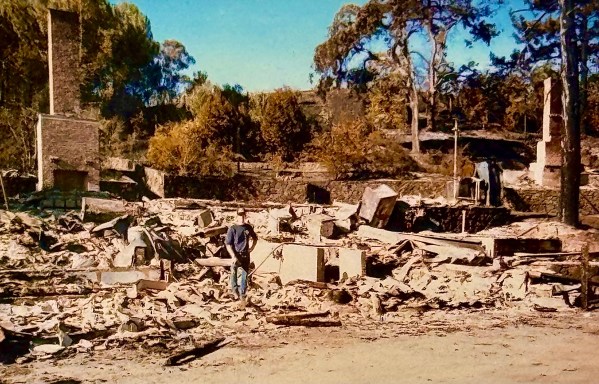
Editor’s note: Menlo Park Fire District retired Chief Harold Schapelhouman (pictured) is looking back 40 years when three separate local wildland fires changed how municipal fires are handled today. Here is Park 1. Part 2 is below.
The Liddicoat Fire, on July 1, 1985, was reported around 3:00 pm and was the work of an arsonist who set multiple fires in thick vegetation along Arastradero Road near Liddicoat Drive in the foothills of Los Altos, Palo Alto and near the borders of Portola Valley and Menlo Park. One hundred degree temperatures, low humidity and off-shore winds at 20 to 30 mph quickly spread the fire, putting hundreds of homes and residents at risk.
Forty years later, firefighters who were there share their stories of chaos, confusion and ultimately success in extinguishing the fire. Almost 300 firefighters in San Mateo and Santa Clara counties were eventually deployed to what became the first and largest municipal mutual aid fire resource request in both counties’ history.
Captain Bill Hembey, with the Menlo Park Fire Protection District, was off-duty and relaxing at home in Redwood City after helping a fellow firefighter pour and finish cement all morning. He turned on his radio scanner and heard the emergency radio traffic for a mutual aid cover request into Woodside and Palo Alto.
Initially, Menlo Engine Four was requested to cover Woodside Station Two and Menlo Engine Six was requested to cover the Palo Alto SLAC Station. That changed quickly with Engine Four re-dispatched to the fire and an off-duty recall to staff a Menlo Reserve Engine put out. Hearing that, Hembey jumped in his personal vehicle and drove to the incident.
On his arrival, he put on his heavy structural firefighting protective equipment and hitched a ride in on a Palo Alto fire engine. There were already several homes on fire, so they picked one with its wood shingled roof just starting to catch fire, determined to save it.
After working for some time in the high heat, they received some help from a helicopter water drop. Hembey and others then began working inside the smokey structure, pulling ceilings and trying to extinguish a stubborn attic fire.
He recalls feeling tired, then being led out of the structure and sitting on the tailboard of the fire engine. After being evaluated by Palo Alto Fire Paramedics, he was transported to Stanford Hospital with heat exhaustion.
Hembey was one of 12 firefighters injured on this fire, mainly from dehydration. Like most of the municipal firefighters at the time, he was never issued light weight yellow brush gear for this type of interface wildland fire incident.
Fire Investigator Phil Constantino, with the Palo Alto Fire Department, heard the emergency call for a grass fire on Arastradeo and Page Mill Road over the radio. He looked out of a window from his office in downtown Palo Alto and saw a large column of smoke rising up from the Palo Alto and Los Altos foothills.
He — and several others — took a vehicle and drove up to the fire. Upon their arrival in the area, they encountered a Los Altos Fire Captain who was doubled over, clearly in distress and complaining of chest pain. They then drove him to a near by Palo Alto Fire Paramedic Ambulance, where he was transported to Stanford Hospital.
Constantino then assisted with fire fighting efforts on Amherst Court. He recalls radio communications problems because critical radio repeater lines running along Arastradero Road were destroyed or damaged by the fire. He was reassigned to investigating what becomes an arson fire with at least three set points — and with Palo Alto Police Officers arresting a suspect.
Battalion Chief Mike Fuge, with the Woodside Fire Protection District, was on-duty when the call came in for a vegetation fire on Arstradero Road near Alpine Road in Portola Valley. As resources arrive in the area, he directs them to where he believes they can best attempt to extinguish, or cut off, the fast moving and erratic wind-driven wildland fire.
At one point, as they work a portion of the fire on a hillside, he’s loses contact with a firefighter on a hose line working in heavy brush. For 10 long minutes he waits and eventually sends other firefighters into the area. They discover a burned off hose line, but not the firefighter. Fuge fears that he may have been trapped, burned or worse. Eventuality, the firefighter is located, but only after having being forced to flee the advancing fire front on foot and in an opposite direction.
Fuge recalls how overwhelmed they were by the fast moving fire and talking directly with Fire Chief Pete O’Brien — with Redwood City Fire Department and the Fire Area Coordinator for San Mateo County — about all of the difficulties with radio communications. That list included common radio frequencies, a lack of interoperability and not having enough portable radios for the safety of each firefighter. This becomes a significant, but sadly common, safety complaint after this fire.
Fire Engineer Lee Caudill, with the Palo Alto Fire Department, was off-duty when he heard about the fire. He drove to the incident and then helped Palo Alto Engine Six’s crew with structural firefighting on Liddicoat Drive and Circle for several hours.
He recalls later walking down Liddicoat to Arastradero and seeing Los Altos Engine 73 abandoned and blocking both lanes of Arastradero Road. He sees the paint on the engine is singed and the roof top emergency warning light was partially melted. He later learned that the engine had stalled in the thick smoke. The firefighters had been overrun by what was described as a “tunnel of fire”, because eucalyptus trees along both sides of the road had exploded into fire with flame heights over 100 feet into the air. Caudill, also a mechanic, was able to get the fire engine running and then drove it to a staging area.
Captain Nick Marinaro, with the Palo Alto Fire Department, was tasked to pickup the agencies water tender at the City corporation yard. He then drove the unit to the end of Liddicoat Circle where the fire is burning homes and has extended into the eucalyptus grove behind them, creating a wall of fire. He witnesses the fire jump over Highway 280 but the embers are unable to ignite in the ice plant surrounding a hillside stucco- sided home with a non-combustible roof. Most, if not all, of the homes that caught fire he recalled, had wood shingled roofs.
Water supply was also problematic, not only because of a lack of water pressure, but because Palo Alto and Los Altos used different size steamer hydrant connections. Most responding units could not hook up to the fire hydrants largest water supply opening because they didn’t have the proper fittings or adaptors.
Marinaro was assigned as the operations chief for the fires overhaul the next day, but the day of the incident, he worked with Acting Fire Chief Don Shaw, who had initially commandeered a media helicopter so he could accurately deploy and guide ground resources over a portable radio, as he flew over them.
Fire Master Mechanic Lynn Hersh, with the Menlo Park Fire Protection District, was requested to respond to the incident because of a fire engine having mechanical problems. Then a Fire Engineer, I was at the shop working on the Firefighters Association antique engine but offered to help and ride along.
Arriving in the area, we parked the shop truck and continued on foot up a fire road in order to find the disabled fire engine. As we progressed up the dirt road, we realized that the fast moving fire was now coming directly towards us. With little time to run or react, we deployed my emergency fire shelter in the middle of the dirt road and both quickly crawled under it.
Hersh recalls seeing a large tree near us burst into flames as the fire swept over us. After several minutes, we emerged from the shelter unscathed — grateful but also shaken. Hersh eventually located the Menlo engine, and I assisted Woodside Engine Two with firefighting operations.
Two helicopters for water drops and two aircraft with retardant were deployed to the fire from the Cal-Fire Ukiah Air Base. They helped slow and stop further expansion of the fire. As the fire begins to be brought under control, another fire was reported at the Stanford Linear Accelerator Center (SLAC).
The SLAC Fire was started by a car fire along north bound Highway 280 and reported as 1/4 mile north of Alpine Road at 6:08 pm. The car fire spread to the grassy shoulder and hillside adjacent to the Center.
Battalion Chief Mike Fuge was redeployed to the SLAC Fire. The fast moving grass fire not only posed a threat to the accelerator buildings themselves, but also had the potential to burn into the Stanford Hills and Weekend Acres residential neighborhoods located in Menlo Park and in unincorporated San Mateo County.
Multiple fire engines, consisting of about 60 firefighters, were redeployed from the Liddicoat Fire to the SLAC Fire, including all air assets, as part of what was called “initial attack”. Thirty foot high flames in overgrown grass and a fully involved car fire on the shoulder of Highway 280 greets the firefighters as they arrive.
Now on Woodside Engine Two, I was the second fire engine to arrive on-scene. We were assigned to the fight the grass fire. The aerial retardant drop caught us all by surprise. I remember someone yelling “hit the dirt”, then looking up and seeing an aircraft coming in our direction and dropping a load of retardant almost directly on top of us. The force of it hits the fire with a thud.
Unfortunately, Menlo Engine Three, with its windows open, took a direct hit of the fine dry powdered and red colored retardant. After the fire, the engine had to be taken out of service for almost a week as the inside of the cab, with retardant everywhere, needed to be thoroughly cleaned.
The SLAC Fire in Menlo Park burned about 30 acres, but by darkness was quickly brought under control. The Liddicoat Fire burned about 150 acres and was the largest fire in the area in 71 years. It was fully extinguished within 24 hours.
Both of these fast moving fires destroyed 10 residential structures, damaged a dozen more, killed four horses, forced the removal of 50 more, and created the need for the evacuation of hundreds of local residents. Together, they caused an estimated $10 million in property damage and injured 12 firefighters and one police officer.
Had the weather not changed, the damage could have been far worse. In addition, while the municipal mutual aid fire system in both counties had worked to swarm the area with firefighters, the level of coordination, communication and type of equipment needed specifically for wildfire response, needed improvement. As did the overall level of public preparedness, early fire detection and community notification.
Unfortunately, only days later, an even larger Wildland fire threat and response would be needed to combat the Lexington Fire in the hills above Los Gatos (See Part 3).
Photo of Harold Schapelhouman after Liddicoat Fire, courtesy of the retired Chief.