



The Other Side of the Creek: Palm Drive’s Open Threshold

Editor’s note: “The Other Side of the Creek” is a series designed to capture the life and spirit just beyond San Francisquito Creek — the shared landmark separating Menlo Park from more southern communities.
Coming from Menlo Park, you step over San Francisquito Creek and then meet El Camino Real — loud, fast, always moving. At the stop light, University Avenue points you straight toward Stanford’s long front approach: Palm Drive. The turn feels ceremonial, even on an ordinary day, as if the street itself knows it is about to slow you down.
Looking back: When Stanford opened in 1891, the road was called University Avenue and was bordered by a mixed landscape of oaks, pines, eucalypts, and other trees. In 1893, Stanford’s first president, David Starr Jordan, championed the idea of lining the entrance with palms; Stanford magazine notes that Jordan persuaded Leland Stanford to embrace the plan, and the palms were planted before the road was paved — roots set before the surface was finished. (More online here).
Two major early sets of gates once stood at the Palo Alto end of Palm Drive, before the 1906 earthquake reset the entrance entirely. The first was modest, more marker than monument: a pair of pillars topped with reclining lion sculptures.

The second design consisted of two substantial, gatehouse-like stone arches (one on each side of the roadway), with tiled, hipped roofs and arcaded walls extending outward. The earthquake erased it.
Distances in the early days felt longer. On foot or by horse-drawn travel meant you’d spend a good five minutes in a kind of overture, where the curtain rises to knowledge at the end.
What stands now is a quieter gate structure. Above each arch, a robed figure sits in a carved niche. On the left side (top photo), she steadies an open book across her lap and lifts a rolled scroll — a clear image of learning as inheritance: knowledge already gathered and preserved.
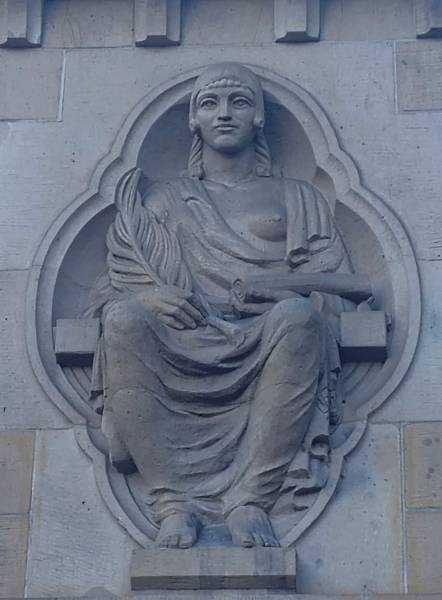
On the other side, her counterpart holds a quill and a page (above): ideas being shaped into language, turned into something that can be shared and kept.
In both figures, the partly exposed chest and classical drapery place them in the realm of allegory, hinting at values meant to be sustaining and not concealed. Together, the two sculptures frame the roadway with a simple instruction as you pass between them: come to read, and leave able to write.
The entrance makes the point quietly: people call them “the gates,” but they do not close. They mark the threshold, not to stop you, but to give you something to think about as you pass.

About the above photo taken on January 19, 2026: With great dignity, on Martin Luther King Jr. Day, we see a message of unity in a great man’s dream. A long crimson banner hangs high across the entrance, stretched between the two gate towers on thin cables. In large white letters, it reads: “Stanford Remembers Martin Luther King, Jr.” The fabric sits like a suspended ribbon— simple, direct, and literally linking both sides of the “gates” with one message of remembrance. In that gesture, the gates become more than stone markers: they become a metaphor for the work his dream asks of us — separate pillars held together by a single line, an open threshold where the distance between “us” and “them” is meant to be crossed.
Author Ardan Michael Blum can be reached online.
Sculpture photos and MLK banner photo by Ardan Michael Blum (c) 2026
Historical photo courtesy of Stanford University


T.D.G January 20, 2026 at 4:34 pm
Lovely article!!
Ardan Michael Blum January 21, 2026 at 1:15 pm
Thank you! I’m really glad you enjoyed it.
Roberta Morris January 20, 2026 at 7:22 pm
This series is a delight.
Ardan Michael Blum January 21, 2026 at 1:13 pm
Thank you very much for these kind words.
Galina January 21, 2026 at 10:33 am
Great article.
Ardan Michael Blum January 21, 2026 at 1:13 pm
Thank you for your comment!
If you’re looking for more, my other InMenlo pieces are here: https://inmenlo.com/author/ardan-michael-blum/
Ardan Michael Blum January 21, 2026 at 1:34 pm
Note: I’m also working on a Palo Alto Tourism Guide—a personal, not-for-profit project with local tips, highlights, and reviews, plus a custom map and a few favorite Stanford viewpoints for first-time visitors. It’s fully independent (no sponsored content): https://diary.ardanmichaelblum.com/palo-alto-tourism-practical-guide/
Jeanne January 21, 2026 at 4:54 pm
Thank you for this interesting article. I’ve see those images on the pillars of the gate countless times … I’m glad to now know what they represent!