

The Other Side of the Creek: The Atomic Age at Stanford

Editor’s note: “The Other Side of the Creek” is a series designed to capture the life and spirit just beyond San Francisquito Creek — the shared landmark separating Menlo Park from more southern communities.
Introduction
There are corners of Stanford where the ground has held more than one kind of future. The Ryan Lab is a prime example. Originally established in 1926 for spectacular high-voltage electrical testing, it was later retrofitted in the 1950s to house a small pool-type nuclear training reactor. Today, the site serves a much quieter purpose as the Ryan Court residential community.
Stanford had broader atomic-age interests during the mid-twentieth century, but this article is narrower. It follows the physical site and documented history of the Harris J. Ryan High Voltage Laboratory: its first life as an electrical-testing landmark, its later use as a nuclear teaching-and-research facility, and its eventual removal from the campus landscape.
First Life
The site’s first future began in fire-white voltage and later — briefly, quietly — shifted into the blue-glow vocabulary of the Atomic Age.
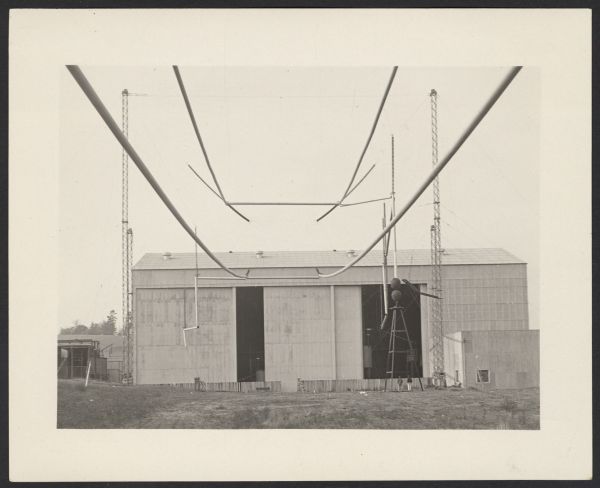
In its first life, the Harris J. Ryan High Voltage Laboratory was built for spectacular electrical work. Named after a Stanford engineering pioneer who shared the Edison Medal ranks with Nikola Tesla and Alexander Graham Bell, it opened in 1926 as the world’s largest university electrical facility. Its primary mission was ambitious: to solve the massive engineering challenges of transmitting electricity over hundreds of miles to power the booming American West.
The sheer power of the facility demanded an industrial, cavernous, hangar-like structure, simply to give its giant transformers enough clearance to prevent millions of volts from accidentally arcing into the walls. At its dedication, Stanford proved the lab’s capabilities by staging a stunning public demonstration around its 2,100,000-volt test station, generating an artificial lightning bolt across a 20-foot gap — a world record for commercial-frequency voltage at the time.
Transformation To Atomic Campus
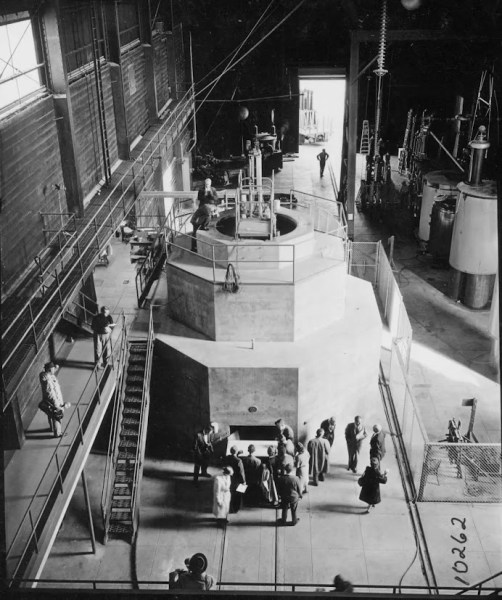
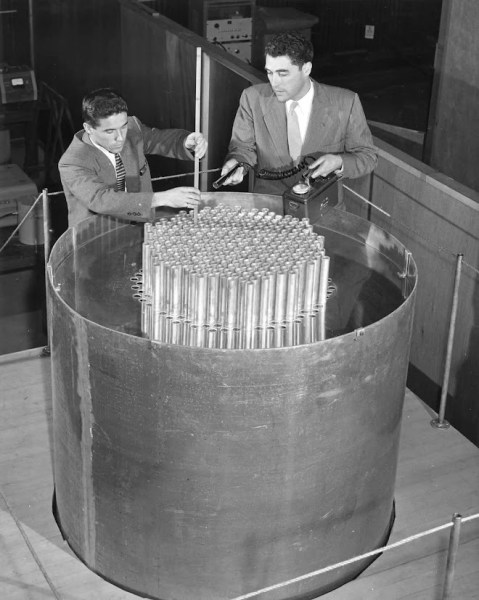
By the mid-1950s, Stanford’s Mechanical Engineering Department had begun building a nuclear program under Professor George Leppert. In 1958, the old high-voltage lab — a space originally scaled for artificial lightning — was remodeled to support nuclear teaching and research. The program started with a subcritical assembly, captured in a 1958 university centennial photo of Leppert and graduate student Gary Vliet, marking a profound period of transformation.
The detail that still surprises Peninsula readers is not the concept of a teaching reactor — it’s the location. This was not a distant, heavily guarded test site in the desert. It was right on Stanford’s campus near Palo Alto, housed in a building that already held decades of electrical history.
Tapping into the region’s emerging commercial atomic industry, the reactor was manufactured just down the road by General Electric’s Atomic Power Equipment Department in San Jose. The design also belonged to a familiar midcentury research-reactor category: a pool-type reactor built for training, experiments, and hands-on nuclear-engineering instruction rather than commercial power generation.
The licensing timeline matters. In November 1959, the Atomic Energy Commission issued Construction Permit No. CPRR-46, authorizing construction of a 10-kilowatt pool-type nuclear reactor facility on Stanford’s campus near Palo Alto. After the reactor was completed and inspected, the AEC issued Facility License No. R-60 on September 28, 1961, authorizing Stanford to possess and operate the 10-kilowatt reactor facility.
A pool reactor is exactly what it sounds like: the core is submerged in a deep tank of water. This specific design helps explain why the government allowed a nuclear core on a college campus. The Stanford Pool Type Reactor, or SPTR, was not a power-generation reactor. It was a small teaching-and-research reactor, operating at a maximum of 10 kilowatts thermal — roughly the thermal output of a few household electric ovens. It required no pressurized containment dome or massive cooling tower. The pool provided cooling through natural convection and served as an effective radiation shield, creating a low-power environment designed for student training and research.
By the mid-1960s, this was not just a novelty bolted onto campus; it was part of Stanford’s evolving engineering footprint. The 1926 structure now held labs, classrooms, and offices for the Nuclear Division. It also hosted a curriculum that is astonishing by modern standards. In 1965, Professor Paul Kruger launched Stanford’s first course in nuclear civil engineering, funded through a training grant from the Public Health Service and the AEC. He brought in scientific figures such as Edward Teller and Nobel laureate Willard Libby as guest lecturers. In the context of the federal Project Plowshare initiative, Kruger’s civil engineering students studied the feasibility of using peaceful nuclear explosions for large earth-moving projects, including artificial harbors and canals.
That point should be kept narrow. This article documents the Ryan Lab reactor site, not every atomic-related activity or theoretical nuclear-engineering discussion connected with Stanford. Some oral histories have associated Kruger’s Plowshare teaching with high-explosive row-cratering demonstrations in the nearby foothills. I have not independently verified those reports in official university records, and they should not be treated as evidence of additional reactor activity on campus.
Stanford’s facility fit a wider national pattern that reads as almost unbelievable today: midcentury America placed training and research reactors on college campuses to build a nuclear workforce. The Stanford Pool Type Reactor operated for a relatively brief period before Stanford sought authority to dismantle the facility in the 1970s.
The Quietest Ending
During the atomic optimism of the 1950s and 1960s, it was common for major research universities to house small-scale nuclear reactors for training students and running experiments. Over the following decades, many of those campus reactors were shut down and dismantled.
Maintaining aging nuclear infrastructure became expensive. As the federal government pushed to remove highly enriched uranium from civilian sites, the costs of converting fuel, managing security, and meeting regulatory obligations made many campus reactors harder to justify. While a few institutions, such as MIT, adapted and kept their reactors running, Stanford’s facility joined the broader wave of closures.
The end of the Ryan Lab was not simply a matter of tearing down an old building. Stanford applied in September 1973 for authorization to dismantle the Stanford Pool Reactor and terminate Facility License No. R-60. The Atomic Energy Commission authorized dismantling in 1974, subject to decontamination, radiation-survey reporting, and inspection. The later NRC license-termination notice stated that the facility had been dismantled and decontaminated, that the component parts and fuel had been satisfactorily disposed of, and that NRC inspection and radiation surveys confirmed the area was available for unrestricted access.
Publicly discussed records also indicate that residual radioactivity was not spread broadly across the property but was limited to a small area beneath the old reactor tank. In 1988, Stanford reported a low-level radioactive patch of concrete, about three by three feet, beneath the tank floor. Before demolition proceeded, crews removed the top two inches of concrete from that specific area and disposed of the material as radioactive waste.
That detail matters because it closes the logical gap between reactor and residence. The former reactor site was not simply converted into housing without a cleanup step. The building and site went through regulated decommissioning, testing, and license-termination review before the land passed out of nuclear-facility use.
And what is there today? Housing — specifically, Stanford’s on-campus residential fabric in the Ryan Court area. Stanford’s own housing listings show the quiet community here: “Ryan Court (Stanford Rental Homes).” The creek corridor is still the geographic tell, but the lab structure is gone; the facility was demolished in the late 1980s. There is no monument, no dramatic marker, and no historic plaque — just daily domestic life where high voltage once arced and, later, a small licensed reactor once operated.
That is the quietest ending: a hangar-like building that held 2.1 million volts, then a 10-kilowatt pool-type teaching-and-research reactor, entirely replaced by a campus neighborhood most people pass without a second thought. If you have memories — an open house, an old professor’s aside, a parent who worked nearby, or a half-remembered line about “the reactor pool” — that is the material local history depends on. The Peninsula’s past often is not loud. It is found in the things that hummed quietly, hidden inside buildings whose functions everyone assumed they understood.

Photo notes
Top photo: “Stanford University, 9-18-26, Dr. H. Ryan’s Electrical Laboratory” typed on the back.
Second photo: “E 178 Condenser connections at the laboratory looking directly at the building” typed on the back. The hangar-like electrical engineering facility was built for very large high-voltage experiments. Contemporary Stanford descriptions note that it was located near “Frenchman’s Dam” on or along Stanford Avenue, on the campus edge toward the foothills.
Third photo: A rare view of Stanford’s Nuclear Technology Laboratory, in the former Harris J. Ryan High Voltage Laboratory in 1961.
Fourth photo: Engineering professor George Leppert, right, and graduate student Gary Vliet take measurements in Stanford’s subcritical nuclear assembly, 1958. The apparatus operated like a reactor but could not sustain a chain reaction. It was located in Stanford’s Nuclear Technology Laboratory.
All photos courtesy Stanford University Libraries, Department of Special Collections and University Archives.
Sources and related records:
- Stanford Engineering: “Preparing Roads over which Culture May Ride in Comfort”
- Stanford Magazine: “Century at Stanford”
- Federal Register, Oct. 4, 1961: Stanford University Facility License No. R-60
- Federal Register, Mar. 18, 1974: order authorizing dismantling of Stanford reactor
- Federal Register, June 30, 1983: termination of Facility License No. R-60
- NRC: Decommissioning of Nuclear Facilities
- Stanford Rental Homes: Ryan Court A
- Lawrence Livermore National Laboratory: The Plowshare Program
- Project Plowshare related DTIC report
Disclaimer and Legal Notice: This piece reflects independent research and historical commentary. The content was researched and revised with the assistance of artificial intelligence tools, including support for fact-checking. AI assistance serves as an editorial aid and does not replace human authorship or independent judgment. No guarantee is made regarding the accuracy or completeness of the data, and content is subject to updates. This article does not constitute professional advice or an official institutional statement.
Disclosure: AI tools assist with research, summaries, drafting, and editorial review. Their use varies by article and stage of the writing process. Ardan Michael Blum writes, revises, and updates the content, shapes its arguments and interpretations, and makes the final editorial decisions.


Grace Delgado March 09, 2026 at 1:57 pm
This is such an amazing article!
Ardan Michael Blum March 09, 2026 at 2:30 pm
Note: The federal record became explicit in late 1959 when the Atomic Energy Commission issued Construction Permit No. CPRR-46, clearing the way for the reactor’s assembly. Following its completion and inspection, the AEC finally issued Facility License No. R-60 on September 28, 1961, officially authorizing Stanford to possess and operate the 10-kilowatt reactor facility on campus.
Vernon Brechin March 09, 2026 at 3:40 pm
Professor Paul Kruger curated courses for training students in skills needed for various Project Plowshare applications. Some of these were adopted on other university campuses. He also demonstrated row cratering using a series of buried high explosives. Remnants of that test shot groove lies in the Stanford University hills, a few hundred feet west of what later became I-280. As a professor emeritus, Paul Kruger had an office with a large image of the Sedan nuclear blast crater behind his desk. I asked him, in the early 1990s, if he believed that someday we might return to such nuclear blasting operations. He seemed hopeful that eventually more people would again see the value in such blasting techniques.
Ardan Michael Blum March 10, 2026 at 1:34 pm
Project Plowshare was officially terminated in 1977, but physicists and astronomers today are using the data from those mid-century underground blasts to model how we might deflect a “planet-killing” asteroid and it is likely that Elon Musk should talk to you before he departs (as soon as possible) to Mars.
Ardan Michael Blum March 10, 2026 at 1:38 pm
Further: To figure out exactly how a nuclear blast would affect an asteroid, researchers at universities like UC Santa Barbara and the Lawrence Livermore National Laboratory use data from Storax Sedan, a famous 1962 Project Plowshare test in Nevada. During that test, a 104-kiloton device buried 194 meters deep displaced over 11 billion kilograms of soil. By studying exactly how that blast lifted the earth, modern scientists can calculate the “coupling efficiency”—the exact conversion rate of explosive yield needed to blow material off an asteroid’s surface to push it in the opposite direction (like a rocket exhaust).
Plowshare data helps researchers determine if it’s better to detonate a bomb next to an asteroid (a standoff explosion to fry the surface and push it) or to bury it deep inside the asteroid using a penetrator missile. Because Plowshare focused heavily on underground detonations and “stress cages” in rock, it provides the only real-world data we have on how solid, rocky bodies react to massive internal nuclear shocks.
It’s important to note that NASA prefers non-nuclear options whenever possible. In 2022, NASA successfully tested the DART mission (Double Asteroid Redirection Test), where they simply crashed a heavy, box-like spacecraft into a small asteroid named Dimorphos. The kinetic impact successfully shortened the asteroid’s orbit by 33 minutes.
However, if we ever spot a massive threat with a short warning time (under 5-10 years), NASA and planetary defense experts agree that a nuclear explosive is our best contingency plan—and the math that might save the world will heavily rely on the cratering tests done during Project Plowshare.
Ardan Michael Blum March 10, 2026 at 1:51 pm
Legal note: I am not familiar with research conducted using high explosives on or near Stanford campus.
T.D.G March 12, 2026 at 1:12 pm
Hi Ardan Michael, fascinating article! You mentioned that the Ryan Lab was completely demolished in the late 1980s to make way for the Ryan Court residential community. Given that the site housed both extreme high-voltage electrical equipment and a nuclear reactor, did your research turn up any information on whether significant environmental remediation or soil cleanup was required before they could build housing on that exact spot?
Ardan Michael Blum March 12, 2026 at 2:17 pm
Hi there,
Thank you for reading the article and for asking such a thoughtful question! You are absolutely right to wonder how a former nuclear and high-voltage laboratory was safely prepared for the residential homes that sit there today.
Based on my research into public records, the Ryan Laboratory site went through an extensive, official cleanup overseen by the Nuclear Regulatory Commission. After the Stanford Pool Reactor was permanently shut down and its nuclear fuel was removed in June 1983, the facility had to be safely dismantled before anything else could happen.
Fortunately, the radiation wasn’t spread across the property; it was actually limited to one very small spot. In 1988, Stanford reported a slightly radioactive patch—only about three feet by three feet—right beneath the floor of the old reactor tank. Before the rest of the building was torn down, crews carefully chipped away the top two inches of concrete from that specific spot and disposed of it safely as radioactive waste. Afterward, extensive soil and concrete tests were conducted to prove the land was safe before the government officially released it for public use.
You also brought up a great point about the extreme high-voltage electrical equipment used at the lab. It is very true that mid-century power facilities often relied on transformers and capacitors containing polychlorinated biphenyls—heavy industrial chemicals that are strictly regulated today. However, looking closely at the historical timeline, I have absolutely no indication that these chemicals were ever used on the site.*
The Ryan Laboratory and its giant 2.1-million-volt testing equipment were built and dedicated in 1926. Polychlorinated biphenyls, however, were not manufactured commercially for use in electrical equipment until 1929. Because the lab was built three years before these chemicals hit the commercial market, those massive original transformers almost certainly relied on highly refined mineral oil for insulation and cooling instead. While it is always possible the lab acquired newer equipment in later decades that did contain them, there are no public records outlining a cleanup of those industrial chemicals overseen by the Environmental Protection Agency.
What the historical records do clearly show is that the land underwent a strict, federally regulated demolition process.
~~
A quick historical note for the detail-oriented: The cleanup actually followed the Nuclear Regulatory Commission’s safety rules of that specific era. The records show they aimed for a maximum radiation exposure of 10 millirems per year. Interestingly, this is actually stricter than the modern federal standard for unrestricted public land use, which was adopted later and allows up to 25 millirems per year.
*Also: The EPA notes that PCBs weren’t commercially manufactured until 1929, three years after the lab’s 1926 dedication.
~~
Important Note: Just a quick reminder that this information is based on my review of public historical records and isn’t an official environmental or legal assessment. For definitive answers or technical specifics, it is always best to check directly with the original government agencies and land records.
~~
Related:
– About Polychlorinated Biphenyls: https://www.epa.gov/pcbs/learn-about-polychlorinated-biphenyls
Ardan Michael Blum March 12, 2026 at 2:21 pm
1865: The Coal Tar Discovery
The earliest precursor to PCBs was discovered as a byproduct of coal tar. At this point, it wasn’t a manufactured chemical, just a naturally occurring chemical anomaly observed during the processing of coal.
1876–1881: First Laboratory Synthesis
PCBs were first intentionally synthesized in a laboratory by German chemists. Oscar Doebner synthesized a version in 1876, and two other chemists, Wilhelm Schmidt and Hugo Schulz, are widely credited with fully synthesizing and describing the chemical structure in 1881.
1881 to 1927: The “Dormant” Decades
This is the most crucial part of the timeline regarding early electrical sites. For nearly 50 years after their invention, PCBs were essentially just an obscure academic curiosity. German chemists knew how to make them in a beaker, but nobody had any practical use for them. They were thick, waxy, heavy fluids that didn’t seem to solve any immediate industrial problems. They were not manufactured, bottled, or sold.
So, what changed in the late 1920s?
As the United States rapidly electrified in the 1910s and 1920s, the power industry ran into a massive problem: they were using highly refined mineral oil to insulate and cool their giant high-voltage transformers. But mineral oil is highly flammable. Transformer explosions and fires were becoming a massive hazard.
The industry desperately needed a heavy liquid that could conduct heat, insulate against high voltage, and not catch on fire.
Engineers eventually realized that those obscure chemicals invented in Germany 50 years prior—PCBs—were the perfect solution. In 1927, the Swann Chemical Company in Anniston, Alabama, figured out how to mass-produce them. In 1929, they officially introduced them to the commercial market under the trade name “Aroclor,” and companies like General Electric and Westinghouse immediately began buying them by the barrel to fill their new transformers.
What this means for the 1926 Ryan Lab:
While PCBs completely existed on a molecular level before 1926, they were strictly a laboratory curiosity. Because Swann Chemical didn’t crack the code on mass-manufacturing them for the electrical industry until 1929, the massive transformers built for Stanford’s Ryan Lab in 1926 would have still relied on the old standard: hundreds of gallons of highly refined (and highly flammable) mineral oil.
Ardan Michael Blum March 12, 2026 at 2:25 pm
On a metaphorical level, it is fascinating to think that these homes are built on the exact tract of land where such immense, world-changing power sources were once achieved and investigated.
Thalia March 12, 2026 at 6:31 pm
This is soooo much fun to read!!
Animap March 26, 2026 at 4:27 pm
Hi Ardan Michael, such an informative article! Your research here is impressive! I really enjoyed reading the article as well as the long explanations at the end! Thank you for enlightening us here !
Ardan Michael Blum March 27, 2026 at 4:39 pm
Thank you so much!
Here is a link to related articles:
https://inmenlo.com/author/ardan-michael-blum/