




The Other Side of the Creek: The Long Harvest of the Stanford Shopping Center
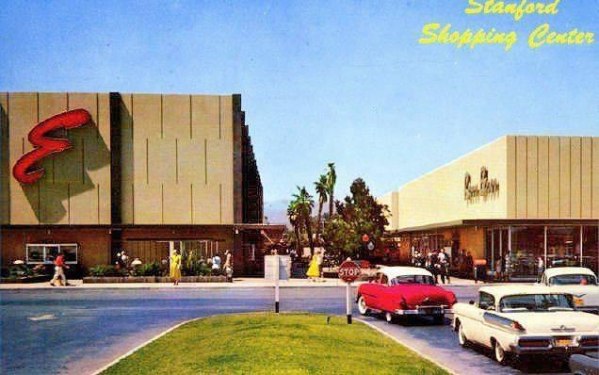
Editor’s note: “The Other Side of the Creek” is a series designed to capture the life and spirit just beyond San Francisquito Creek — the shared landmark separating Menlo Park from the communities to the south.
There are corners of Stanford where the ground has carried more than one idea of the future. For many of us in Menlo Park, Stanford Shopping Center has long felt like a natural extension of our own backyard — the place just over the creek that is close enough for morning errands, a mid-day lunch, or the occasional weekend indulgence. The short bridge over San Francisquito Creek acts as a portal between the quiet, leafy residential streets of Menlo and the polished promenades of what is arguably the Peninsula’s most storied retail destination.
But before the storefronts, fountains, and polished promenades, this was open Stanford land. It was a rugged, working landscape far removed from the luxury of today. This was former Stanford agricultural land, including vineyards and hayfields, that once stretched near El Camino Real and San Francisquito Creek. It functioned as a vital part of the broader agricultural operation of the old Palo Alto Stock Farm, a place where the dust of the fields was more common than the scent of expensive perfume.
That older landscape is not incidental to Stanford’s identity; it is the bedrock upon which the university was built. The university’s enduring nickname, “the Farm,” isn’t just a marketing quirk — it comes directly from the Palo Alto Stock Farm created by Leland Stanford to breed world-class trotting horses. When Leland and Jane Stanford drafted the university’s future, they ensured the Stanford Founding Grant prohibited the sale of the university’s granted lands, which pushed Stanford toward a strategy of long-term leasing rather than outright liquidation. This legal maneuver created an institution that was unusually rich in real estate yet paradoxically limited in its ability to convert that land into immediate cash. Over time, as the university matured, these holdings grew to a staggering 8,180 acres of contiguous land.
After World War II, this institutional constraint transformed into a brilliant financial opportunity. As Stanford expanded under the leadership of visionaries like Wallace Sterling and Frederick Terman, the need for flexible, unrestricted income became desperate. The university couldn’t sell its acreage to pay for new laboratories or faculty salaries, so it turned to its “real estate czar,” Business Manager Alf Brandin. Brandin realized that the university could essentially act as a sophisticated landlord. This strategy helped shape the Stanford Research Park — the birthplace of Silicon Valley —and, eventually, the shopping center. What appeared to shoppers as an elegant suburban retail destination also represented a larger, radical financial idea: make the land support the university’s academic mission without ever giving up a single square inch of the soil.
The shopping center arrived in carefully choreographed stages, reflecting a university that was learning to navigate the commercial world. Excavation began in 1954 on land that had been associated with Stanford’s agricultural output for nearly a century. The transition from tractor-turned soil to paved parking lots was a signal that the Peninsula was shifting from an agrarian economy to a suburban one. The first store to open was Roos Brothers, a venerable name in West Coast apparel, which welcomed its first customers in September 1955.
The formal dedication followed on February 23, 1956 — a day that has lived on in local lore thanks to the presence of Shirley Temple Black, who cut a massive nine-tiered cake to mark the occasion. By the time the original complex reached completion later that year with the opening of Blum’s restaurant in October, it was clear that Stanford wasn’t just building a few stores; it was creating a regional landmark. Contemporary accounts describe the early center as a massive undertaking of nine buildings and forty-five businesses, a scale that was practically unheard of for a university-owned commercial project at the time.
Sources attribute the original architectural design to Welton Becket & Associates, the firm behind many of California’s mid-century icons. Perhaps even more influential was the landscape design, which is associated with Lawrence Halprin & Associates. Halprin was a pioneer who believed that urban spaces should be experienced as a series of “events” and movements. From the outset, he and Becket conceived the center as an open-air environment rather than a conventional, sterile strip development. They used planted walkways, hidden courtyards, and generous circulation to define its character. It was designed to feel like a garden as much as a marketplace, a philosophy that respected the site’s history as a place of growth.
That open-air identity proved to be a stroke of genius that made the center unusually durable. In the late 1970s, as the “enclosed mall” craze swept across America, many retail centers were being boarded up and sealed off from the elements. Stanford went the other direction. The firm Bull Field Volkmann Stockwell worked on major renovations, and Architectural Record featured the modernization in 1977 for its “theatrical” approach to outdoor space. By emphasizing the California climate — rather than trying to hide from it—the center avoided the fate of the “dead mall” trend that eventually claimed so many of its contemporaries. It remained a place where you could feel the breeze from the Santa Cruz Mountains while you browsed.
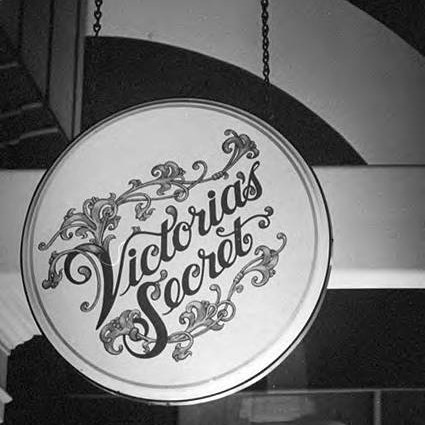
The center also occupies a small but fascinating place in the global retail zeitgeist. On June 12, 1977, Roy and Gaye Raymond opened the first Victoria’s Secret store at Stanford Shopping Center. Long before it was a mall-staple found in every corner of the world, it was a niche Peninsula experiment born out of Roy Raymond’s personal awkwardness when trying to buy lingerie for his wife in traditional department stores. The boutique atmosphere they cultivated here — designed to feel like a Victorian gentleman’s study — was a direct reaction to the impersonal retail environments of the era.
A new phase of this land-use story began in 2003, when Stanford transitioned the day-to-day management of its retail crown jewel by entering into a 51-year lease with Simon Property Group. This wasn’t a sale; it was a sophisticated evolution of the ground-lease strategy Brandin had pioneered decades earlier. Stanford retained ownership of the land beneath the center, preserving the integrity of the original grant, while the university’s financial reports recorded roughly $333 million in prepaid lease income at signing. This infusion of capital allowed the university to fund critical academic infrastructure, while contemporary reporting on the transaction stated that Stanford would continue to receive about 25 percent of the center’s adjusted annual rent moving forward.
Seen this way, Stanford Shopping Center is much more than a collection of luxury storefronts. It is a long, multi-generational land-use story centered on one specific piece of geography. It is a narrative of continuity: from the agricultural world of the old Stock Farm to the university’s modern leasing strategy; from the dusty vineyards and hayfields of the 19th century to the polished boutiques and department stores of the 21st. The surface of the ground has changed completely — from soil and vines to slate and glass — but the underlying logic has not shifted an inch. Stanford found a way to make land it was meant to keep continue working for the institution, ensuring that “the Farm” remains productive long after the last hay was harvested.
Disclaimer: This article is intended for informational and editorial purposes only and reflects independent research and interpretation. Although care has been taken to ensure accuracy, some details may be incomplete or subject to change. Nothing here should be considered professional advice or an official statement by any institution mentioned.


T.D.G March 23, 2026 at 4:34 pm
This is such a fun article!!
Cristina March 24, 2026 at 2:39 pm
Great article on the history of the shopping center. I remember as a young girl watching the monkeys in the window of a shoe store. Perhaps around 1966? I always think of the monkeys as I walk down the same corridor today.
Ardan Michael Blum March 24, 2026 at 4:28 pm
Thank you so much Cristina!
Sommer & Kaufmann was the store. The enclosure typically housed two or three live spider monkeys. They lived in a glass-enclosed habitat that was visible from both the sidewalk and the children’s shoe department inside. The store was part of the original “First Nine” buildings of the mall. It was located as an “inline” store (meaning not one of the giant anchors like The Emporium), positioned in the central corridors near what were then the main fountains. For children in the late ’50s and ’60s, it was the ultimate distraction. While a salesperson used the old metal “Brannock Device” to measure your feet, you could watch the monkeys swing on ropes and branches. It was a classic example of “experience retail”—a strategy used to make shopping a family outing rather than a chore.
Julian Ren-Moss March 24, 2026 at 4:21 pm
It’s fascinating to see the business strategy behind the ‘Farm.’ Alf Brandin was definitely ahead of his time, finding a way to turn the land into a goldmine for the university without actually selling it off. I love that the shopping center helps pay for tomorrow’s research while still keeping its historical roots.
Ardan Michael Blum March 24, 2026 at 4:38 pm
Thank you Julian.
Alf Brandin, who managed Stanford’s business affairs for 24 years, died November 18, 1999 at Stanford Hospital after a stroke. He was 87. See details: https://stanfordmag.org/contents/he-broke-new-ground and https://www.paloaltoonline.com/morgue/community_pulse/1999_Dec_1.LEADOBIT.html
Ardan Michael Blum April 22, 2026 at 6:57 pm
New: “Palo Alto: A City Shared by Temporary Achievement and Permanent Life” — Essays exploring how Palo Alto exists between tech, academia, and neighborhood life, where temporary ambition and long-term residence overlap within the same streets and routines.
See https://www.ardanmichaelblum.com/palo-alto/