




Remembering the great 1906 San Francisco Earthquake and Fire 120 years ago
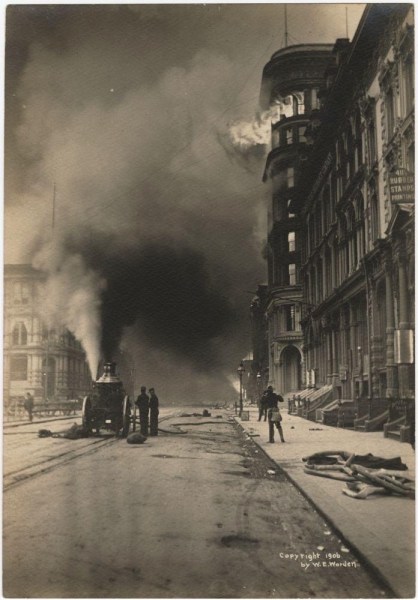 April 18, 2026, is the 120th anniversary of the great 1906 San Francisco Earthquake and Fire, memorialized and remembered at 5:14 am, the exact time when the earthquake struck.
Proceeded by a foreshock, the magnitude of the incident, which occurred before monitoring and scaling became standardized, is often debated as a 7.7 to 8.3 magnitude event lasting 42 seconds. Perhaps most remarkable, it was reportedly felt from Los Angeles to Oregon to central Nevada. The earthquake occurred on the San Andreas fault, impacting some 280 miles of the fault line and impacting multiple communities.
Over the years, fatality estimates have been revised for the entire region. It is now believed that some 3000 people were killed, placing this earthquake in the top 10 most catastrophic, deadliest and destructive events in the nation, slightly above the 2,974 victims of the 9/11 who died in the terrorist attacks on New York City in 2001.
While San Mateo County miraculously reported no fatalities, it did sustain significant damage to many structures. Locally, in Menlo Park and Atherton, significant and major structural damage and collapse was visible at Saint Patrick’s Seminary, Sacred Heart School and Duff and Doyle’s Mercantile Emporium Store, but fortunately all were spared from fire, despite being heavily damaged.
In 1906, the population of Menlo Park was measured in the hundreds while San Mateo County’s population was reportedly in the low thousands. A doubling of that population occurred in both jurisdictions, in the years after the earthquake. It’s important to remember that at the time, San Francisco was the ninth largest city in the Country with a population of 410,000, with at least 250,000 people being displaced after the earthquake and fires. Many stayed in 26 established refugee camps in San Francisco or across the Bay in Oakland and Berkeley.
Santa Clara and Sonoma Counties were not so lucky. The Stanford Campus in Palo Alto reported two deaths and suffered major damage, especially to the many arches, Memorial Church, gymnasium, library and multiple other damaged buildings.
Downtown San Jose suffered multiple collapsed structures followed by several significant fires which firefighters miraculously brought under control by nightfall because of an adequate water supply. The total number of fatalities in Santa Clara County was reportedly at 102 victims, with the majority of fatalities in the San Jose area.
To the North, Santa Rosa in Sonoma County reported up to 85 fatalities and significant damage to almost the entire city. Outside of San Francisco, it was considered the most significantly damaged area. Similar to San Francisco, the earthquake destroyed and damaged many structures and the situation was complicated by multiple fires where its firefighters struggled to bring them all under control in the days after the earthquake because water supply was a factor.
One Fire Chief’s tale
In San Francisco, Chief Engineer Dennis T. Sullivan had returned to his family living quarters at 2:0 am, after responding to a second alarm fire in North Beach. The Fire Chief and his wife Margaret lived on the third floor of Chemical Fire Company 3’s quarters located at 410 Bush Street.
In order to not disrupt his wife’s sleep, he often slept in another bedroom after being called out to a fire. When the earthquake struck, the ornamental dome of the California Hotel located next door to Fire Station 3 toppled over piercing through the roof and continued through the third and second floors, ending up on the first floor and/or in the cellar below.
In the darkness, Chief Sullivan blindly searched for his wife but instead fell from the third floor into the cellar due to the collapse. Despite a skull fracture, four broken ribs, a punctured lung, deep lacerations to his hip and burns from hot steam and water, he was able to crawl from the rubble gravely injured, even as the crew from Station 3 searched for him and his wife. Mrs Sullivan was also located and was also seriously injured in the collapse.
Dennis Sullivan was hired as a hoseman with the San Francisco Fire Department in 1877, he rose through the ranks and became Chief Engineer in 1893. Under his leadership, he organized the Fire Department to a very high standard of efficiency.
In 1900 he transitioned the Fire Department to a full time paid professional organization. In 1903 he implemented important standards and physical abilities testing. At the time of the earthquake and fire, the SFFD had 584 firemen, 45 fire stations, 36 engine companies, 8 Truck Companies, 7 Chemical Companies, 1 Water Tower and 2 Monitor Batteries.
The earthquake and subsequent fires damaged or destroyed 25 stations and 14 pieces of emergency equipment. Initially, 100 firefighters were reported to be missing and feared dead. Fortunately, that was not the case, but Truckman James O’Neil was killed at Truck Company 1 on O’Farrell Street in another fire station collapse.
While the earthquake had caused significant structural damage to the City, it was the many fires, usually started by gas leaks, or intentionally, that were becoming a bigger problem, especially with little to no working water supply, despite the availability of 4,000 fire hydrants.
The fire fight began on the 18th and continued on for four days until the dawn of 21st when the fire was finally brought under control. Exhausted firefighters could often be found sleeping on the ground next to their equipment and yet they continued to fight on, building by building, block by block, often against impossible and frustrating conditions.
At one point, the larger fires in the downtown area combined together to create a three mile wide wall of fire. Two private fire boats were brought into to help save the Ferry Building and some of the warehouses along the seaport. Dynamite was used to blow up structures to create fire breaks but consequently created there own set of problems.
In totality, 85% of the City, or 4.7 square miles, 490 city blocks, consisting of 28,000 wood and masonry structures were destroyed by the fire. The estimated loss was $524 million dollars.
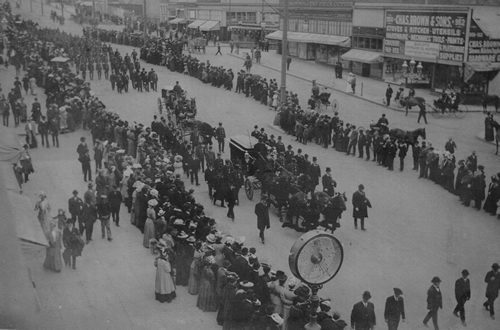
At the age of 53, Chief Sullivan died from his injuries at Letterman Hospital five days later on April 22nd. His wife survived and eventually recovered, but was unable to attend his funeral and memorial service held a year later (pictured above).
For years Chief Sullivan had advocated for an auxiliary water supply system that was not only gravity fed by elevated reservoirs but the addition of two fire boats that could pump sea water into a high pressure and volume manifold system. Each boat capable of pumping 10,000 gallons per minute.
In 1909, three years after his death and the conflagration, $279,618 was spent to create the auxiliary water supply system. Two fireboats were purchased, but perhaps most fittingly, one was named the Dennis T. Sullivan.
Harold Schapelhouma is the retired Chief of the Menlo Park Fire Protection District and serves as the organization’s historian


T.D.G April 18, 2026 at 2:00 pm
Extraordinary reporting / article!
irene lawrence April 18, 2026 at 9:04 pm
My grandmother, who was born and raised in “the city,” impressed on me that the event must always be referred to as the 1906 San Francisco Earthquake and Fire. She would have appreciated Mr. Schapelhouma’s accuracy!
Ardan Michael April 19, 2026 at 12:12 am
Yes!!
Really first rate!
Bill Koenig April 19, 2026 at 5:42 am
Great read, Chief, Congrats!
Thomas Olavson April 21, 2026 at 7:32 pm
Interesting read – thank you! I had never thought about how the earthquake affected surrounding areas like Stanford and San Jose.
John Rohrer April 22, 2026 at 6:54 pm
Harold,
You have created a work of art with this article. Knowing you, as I do, I would like all of your readers of this important article to understand that your accuracy is only one of your many attributes. As a former firefighter/fire officer, I am quite proud of you.
My compliments and pride,
John H. Rohrer, Capt, retired, Menlo Park Fire protection District.
Bill Hembey April 22, 2026 at 7:08 pm
That was was a great, very informative article about how all the counties in the Bay Area were affected. Great job, and thanks for the article.