



The Other Side of the Creek: What Hopkins Creekside Park Actually Preserves
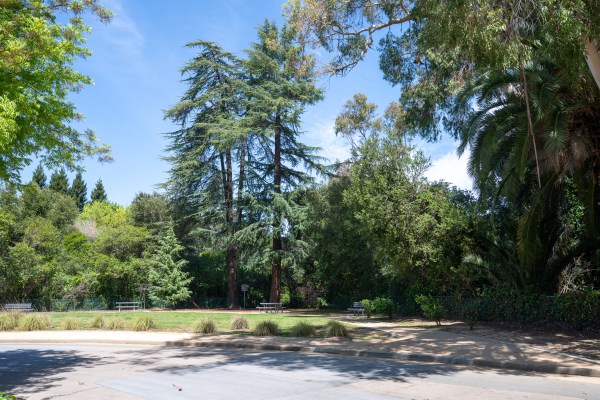
Editor’s note: “The Other Side of the Creek” is a series designed to capture the life and spirit just beyond San Francisquito Creek — the shared landmark separating Menlo Park from the communities to the south.
San Francisquito Creek looks like a boundary, and in a narrow geographic sense, it is. It separates Menlo Park from Palo Alto. But historically, it has done something more subtle: it has allowed memory to drift. Places on one side are attributed to the other. Names persist while the underlying geography disappears. Over time, a park, an estate, and a surviving building begin to collapse into a single, imprecise story.
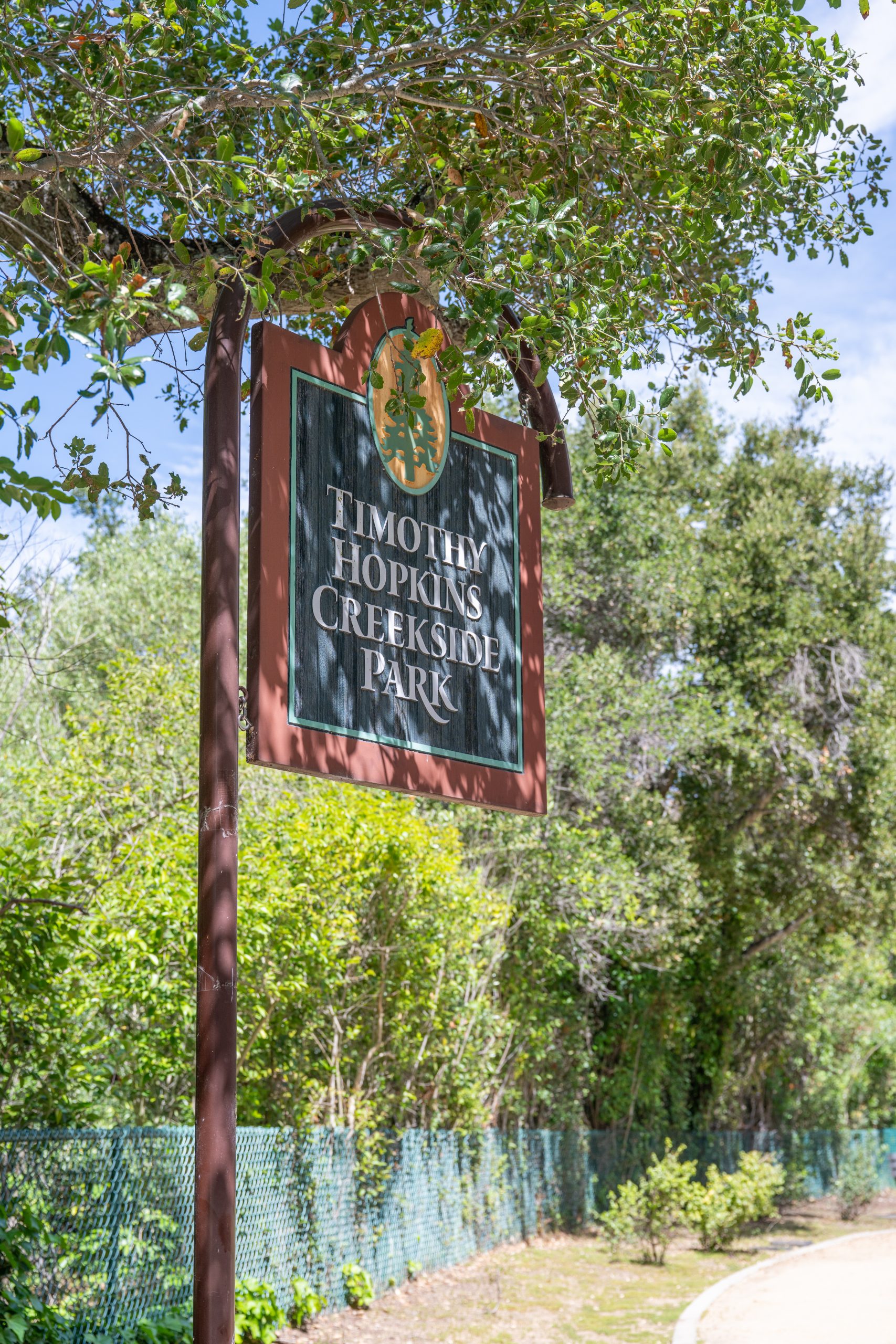 Hopkins Creekside Park sits on the Palo Alto side of that line. It is a narrow, linear strip —about 12 acres in total, extending roughly 1.5 miles along the creek — and rarely more than a couple hundred feet wide. The land was formally deeded in June 1907 by Timothy Hopkins and his wife, creating a buffer between urban development and the creek corridor. That act of preservation is the origin of the park as it exists today.
The landscape still reflects that decision. Unlike the surrounding grid, the park follows the irregular logic of the waterway. Valley oaks and California buckeyes form a dense canopy in places, and the path traces a route that feels closer to a remnant than a designed space. It functions as an ecological corridor, but also as a visual interruption — a place where the city yields, briefly, to something older.
Long before the 1907 deed, this stretch of creek was part of the inhabited landscape of the Ohlone. Seasonal movement, food gathering, and settlement patterns were tied to waterways like San Francisquito Creek for thousands of years. The park does not recreate that world, but it does preserve a fragment of its physical setting.
The modern framing, however, comes from the Hopkins name — and that is where the historical record requires precision.
Timothy Hopkins is often described, with some justification, as a central figure in the creation of Palo Alto. He financed and organized the subdivision initially known as University Park, contributed to its early planning and identity, and served for decades as a trustee of Stanford University. His influence on the early town is well documented.
But he did not live in Palo Alto.
He lived across the creek, in Menlo Park, at an estate known as Sherwood Hall.
This distinction is frequently blurred, in part because other Hopkins-associated sites remain visible while Sherwood Hall does not. The property now known as Vallombrosa, on Oak Grove Avenue, is regularly misidentified as “the Hopkins estate.” It is indeed linked to the Hopkins family, but to Edward Whiting Hopkins, not to Timothy Hopkins. The association is real, but it belongs to a different person and a different property history.
Sherwood Hall was Timothy Hopkins’s residence. Originally called Thurlow Lodge, the estate was acquired by Mary Hopkins, widow of Mark Hopkins, and later transferred to Timothy Hopkins. Contemporary descriptions place the estate at roughly 280 acres —extending from San Francisquito Creek north toward Ravenswood Avenue, and from the railroad corridor west toward Middlefield Road. In present-day terms, it covered a substantial portion of what is now central Menlo Park.
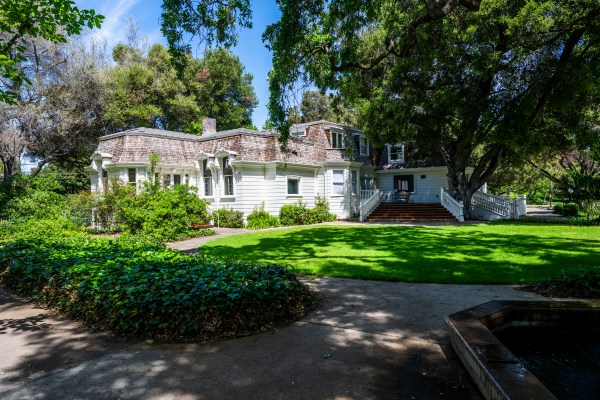
That scale is no longer visible. The main house — a large Gilded Age mansion — was severely damaged in the 1906 San Francisco earthquake and was not restored as a primary residence. After that point, Hopkins moved into the estate’s gatehouse. That structure survives today at 555 Ravenswood Avenue, commonly referred to as the Latham-Hopkins Gatehouse, and it is the closest remaining physical connection to his residential life.
The estate itself has been subdivided and absorbed into the modern city. Streets, parcels, and institutions now occupy what was once a continuous property. The mansion is gone. The boundaries must be reconstructed from historical descriptions. What remains is fragmentary.
This is what produces the confusion.
Hopkins Creekside Park is a donation, not a residence. Vallombrosa is a Hopkins family property, but not Timothy Hopkins’s home. Sherwood Hall is the correct residence, but it has largely disappeared from the landscape. The gatehouse survives, but without its original context, it reads as an isolated structure rather than part of a much larger estate.
Each piece is accurate on its own. The errors emerge when they are combined.
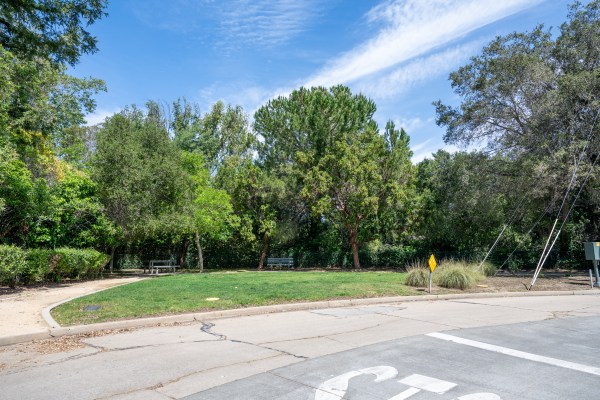
The park, meanwhile, continues to function within a contemporary framework. It is maintained by the City of Palo Alto and forms part of a broader system of environmental management along the creek. Flood control and habitat preservation efforts — coordinated in part by the San Francisquito Creek Joint Powers Authority — have introduced infrastructure changes while attempting to preserve the ecological character of the corridor.
So the site operates on multiple levels at once.
It is a piece of early twentieth-century land preservation. It is a remnant of a much older ecological and cultural landscape. And it is tied, by name, to a figure whose most significant contributions to Palo Alto were made from outside its boundaries.
That final point is the one most often lost.
Timothy Hopkins helped shape Palo Alto, but he lived in Menlo Park. His estate was Sherwood Hall, not Vallombrosa. The land that became Hopkins Creekside Park was given to the city in 1907, not retained as a residence. The only surviving structure connected to his domestic life is the gatehouse on Ravenswood Avenue. The creek still marks the division. But understanding the history requires resisting the tendency to smooth that division away.
Disclaimer: This article is intended for informational and editorial purposes only and reflects independent research and interpretation. Although care has been taken to ensure accuracy, some details may be incomplete or subject to change. Nothing here should be consideed professional advice or an official statement by any institution mentioned.
Photos by Robb Most (c) 2026


Ray Traub April 27, 2026 at 3:05 pm
A great article.
Menlo Muddled April 27, 2026 at 3:25 pm
Correcting a local myth about Timothy Hopkins is just great to read!
Trish April 28, 2026 at 12:49 pm
Fascinating piece! I’ve lived in the area for years and definitely fell victim to the myth about Vallombrosa being Timothy Hopkins’s home. Thank you for clearing up the history and shedding light on Sherwood Hall and the surviving gatehouse on Ravenswood.