



Beware of poisonous mushrooms in Menlo Park and surrounding areas
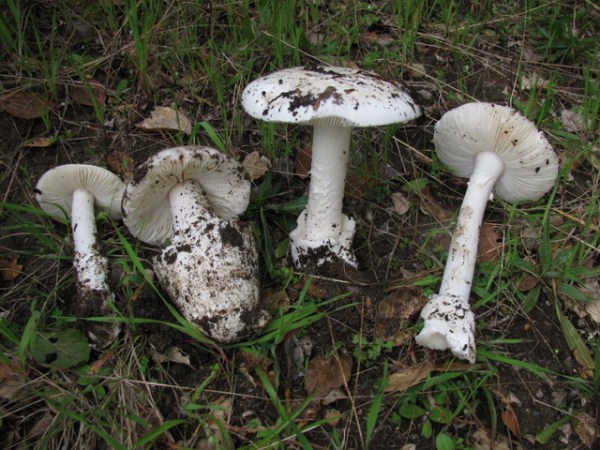
In early May while tending the garden of my home in Menlo Park, I came across two nondescript mushrooms emerging from the mulch. “Toadstools,” I thought, pulled them up by hand and discarded them. There was nothing unusual or worrying about them. The caps and stems were white. Because toadstools frequently emerge after a period of rainfall, I did not give them another thought.
Only a few days later our puppy of 12 weeks of age, Maple was in a veterinary ICU with liver failure and the only option for her was to be euthanized. A lab test confirmed that Maple had, in some way not known to us, been exposed to a highly toxic mushroom in our backyard and her exposure led rapidly to liver failure. There is no treatment for liver failure aside from a liver transplant, which, of course, is not available to pets. In her heartbreakingly short life, while waiting out the usual puppy vaccine period, she had never left our home and yard.
While many people have heard of the lethal “death cap” mushroom, Amanita phalloides, fewer have heard of its equally deadly relative, Amanita ocreata, the “destroying angel.”
Amanita ocreata (pictured top) is every bit as dangerous as the better-known death cap mushroom. Perhaps it is more dangerous because it masquerades so innocently as an ordinary white-capped “toadstool” and resembles many varieties of edible mushrooms. It is found from January through April exclusively in mixed woodland areas along the Pacific coast of North America, from Vancouver to Baja. It is typically found near or under coastal live oaks and particularly likes the Bay Area weather. Ocreata emerges from the soil in the spring, following damp weather as we recently experienced.
We are now in a period in which the Bay Area Amanita bloom is greater than in the last several decades, and is greater than any other part of the U.S. Consequently, this year human deaths are reported to be tenfold greater than in past typical years, according to the UCSF poison control center. What was once an uncommon hazard is now increasingly common.
 It is also important to mention the “death cap” mushroom, Amanita phalloides (second photo) which is responsible for 90% of mushroom fatalities. Once found only in Europe, it has now spread throughout North America. Like ocreata, the death cap grows under or near California coastal oaks and to a lesser extent conifers, but unlike ocreata emerges from the soil in the late summer, autumn and winter when California weather is damp yet temperate.
Ingestion of either of these mushrooms is a medical emergency for humans and pets alike; ingestion of as little as one-half of a mushroom is enough to kill an adult human. Both mushrooms cause rapid liver failure within days of ingestion. There is no known antidote for their toxin. Medical treatment is only supportive and will only be successful if treatment begins within hours of ingestion. If started too late, as is usually the case, the only definitive measure available to people is liver transplantation.
It is commonplace to see families picnicking on park lawns while their infants and toddlers crawling or toddling to explore their environment, and of course, explore by putting anything interesting in their mouths. Mushrooms emerging from the ground are an attraction to curious young pets and small children alike.
In this year, and possibly in future years, these deadly mushrooms are becoming more commonplace where we live: therefore be alert for mushrooms in your home gardens, parks, and green spaces. If you see any, please unroot them and discard them (and then wash your hands).
Removing found mushrooms may be one of those small daily acts that may save a life.
Elliot Krane, an emeritus professor of Stanford University School of Medicine, has been a local resident for more than 30 years.
Photos from Wikipedia


Chris Mac May 24, 2026 at 6:04 pm
I am so very sorry. That is heartbreaking.
Kenneth R Wilsher May 24, 2026 at 7:19 pm
It is sad that pets will eat these poisonous mushrooms. The best way to identify Amanita mushrooms is to look for the “cup” or volva at the base of the stalk. It is supposed to be quite safe to handle them, and I have often done so, being careful to not put my hand anywhere near my mouth afterwards.
Best not to eat any wild mushroom unless identified as 300% safe.
Elliot Krane May 25, 2026 at 6:12 pm
Kenneth,
Thank you for adding your important points. In hindsight, yes, our backyard toadstools had volvas at their base. Very worrisome is that our across the street neighbor had found several mushrooms under a live oak that have volvas and yellow-green caps, more like phalloides.
Elliot