




Final footsteps: remembering 9/11 twenty-five years later
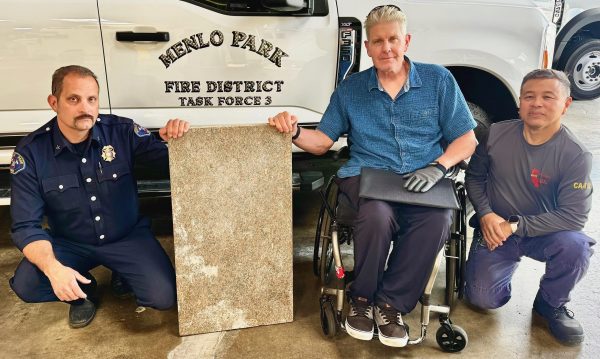
Twenty five years after responding to the collapse of the World Trade Center (WTC) Towers and destruction of the 16 acre multi-building complex in New York City on September 11, 2001, the Menlo Park Fire Protection District’s National Urban Search and Rescue Team (US&R), known as California Task Force 3 (CA-TF3), is building a memorial to commemorate the event.
Almost 1,000 9/11 memorials are located across the country with dozens scattered across California. What will make Task Force 3’s unique: the 9/11 memorial will be combined with its Oklahoma City Bombing memorial. The local, State (Cal-OES) and Federal (DHS-FEMA) response team responded to both terrorist events. Outside of New York City and Oklahoma City, no such pairing exists, let alone one created by the first responders themselves.
But the story doesn’t end there. As part of the team worked their last night shift at the end of September on the “pile” at ground zero — respectfully and methodically recovering human remains and delayering the debris field — other members were packing up the gear at the team’s forward equipment staging area located between WTC buildings 4 and 5 in the plaza, in preparation for a fresh, new Task Force rotation into the site, and their demobilization in order to return home.
After seeking on-site authorization, team members pulled up a loose and intact plaza paver measuring 20 inches wide and 3 feet long, placing it in a large forklift-able row pack equipment container. When the teams returned home, it was moved to a team member’s garage for safe keeping, where it was located behind a cabinet and has sat for 24 years. It was recently moved to the Task Force’s warehouse with the discussion of what to do with it started anew — and research revealed how unique and precious it truly is.
In 1998 and 1999, the Port Authority that manages the site spent $12 million on the renovation of the Austin J. Tobin World Trade Center plaza. The entire plaza decking was replaced with 40,000 highly durable, North American gray and pink granite panels that came from the Stoney Creek Quarry in Branford, Connecticut.
Located 80 miles northeast from New York City, the quarry is famous for supplying the stone for other iconic New York City landmarks like the Statue of Liberty, Grand Central Station, and the Metropolitan Museum of Art.
Most of the granite panels in the plaza were pulverized, crushed, destroyed or damaged, when the two 110 story towers collapsed, resulting in 600,000 tons of falling debris destroying the WTC complex.
On a typical weekday before 9/11, it is estimated that tens of thousands of people walked across those plaza panels. In the three years after they were installed and before the disaster, it is estimated that well over 100 million footsteps crossed over them.
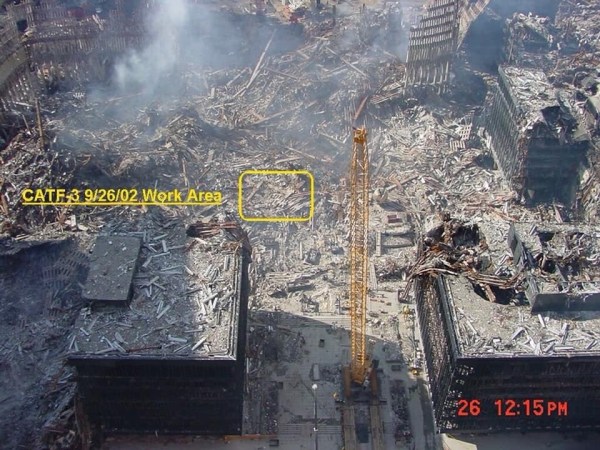
After the terrorist attacks, recovery efforts included using heavy excavators to remove all of the debris from the site. Whatever granite plaza panels that had survived the collapse were forcefully torn out, loaded into dump trucks, and hauled away to a dump site only later to be rechecked for human remains.
From 2010 to 2016 the Port Authority of New York City and New Jersey operated an artifact preservation program. Requests poured in from across the country so memorials could be created. The majority of the requests were for the iconic twisted structural steel, but the other option was “rubble packages” consisting of mixed debris, including portions of plaza granite.
In 2002, as excavation reached the bottom of the sub-surface rubble pile, workers discovered crates of the original granite replacement panels that were tightly banded and stored together in the basement. They were completely intact and had been spared by the collapse and subsequent fires. So while unused replacement plaza granite panels still exist, the one saved by Task Force 3 may well be one of only a few intact survivors. And even more rare and significant, one of the very last to have experienced the “final footsteps” of those who fled from this tragedy.
While the new memorial won’t be completed by the 25th anniversary of this tragic event, renewed efforts are underway, and the team is working with a structural engineer on formal drawings, permits, approvals, moving the Oklahoma City Memorial, and gathering the appropriate components for the 9/11 Memorial to build it.
Top photo pictured left to right – Menlo Park Fire District Battalion Chief John Wurdinger, CA-TF3 US&R Program Manager; the surviving WTC Granite Plaza Panel; CA-TF3 Foundation Treasurer and retired Fire Chief Harold Schapelhouman; and CA-TF3 Warehouse Manager Ben Villao
Second photo: The World Trade Center complex and plaza granite decking panels were mostly destroyed by the subsequent collapse and eventual debris removal. CA-TF3 photo taken on September 26, 2001 was used to document areas of human remains discovery and delayering progress. The area near the crane between buildings 4 and 5 was the teams’ forward staging area and where the surviving plaza panel was removed by members of Task Force 3 prior to their departure.
Photos courtesy of Harold Schapelhouman


Leave a Comment